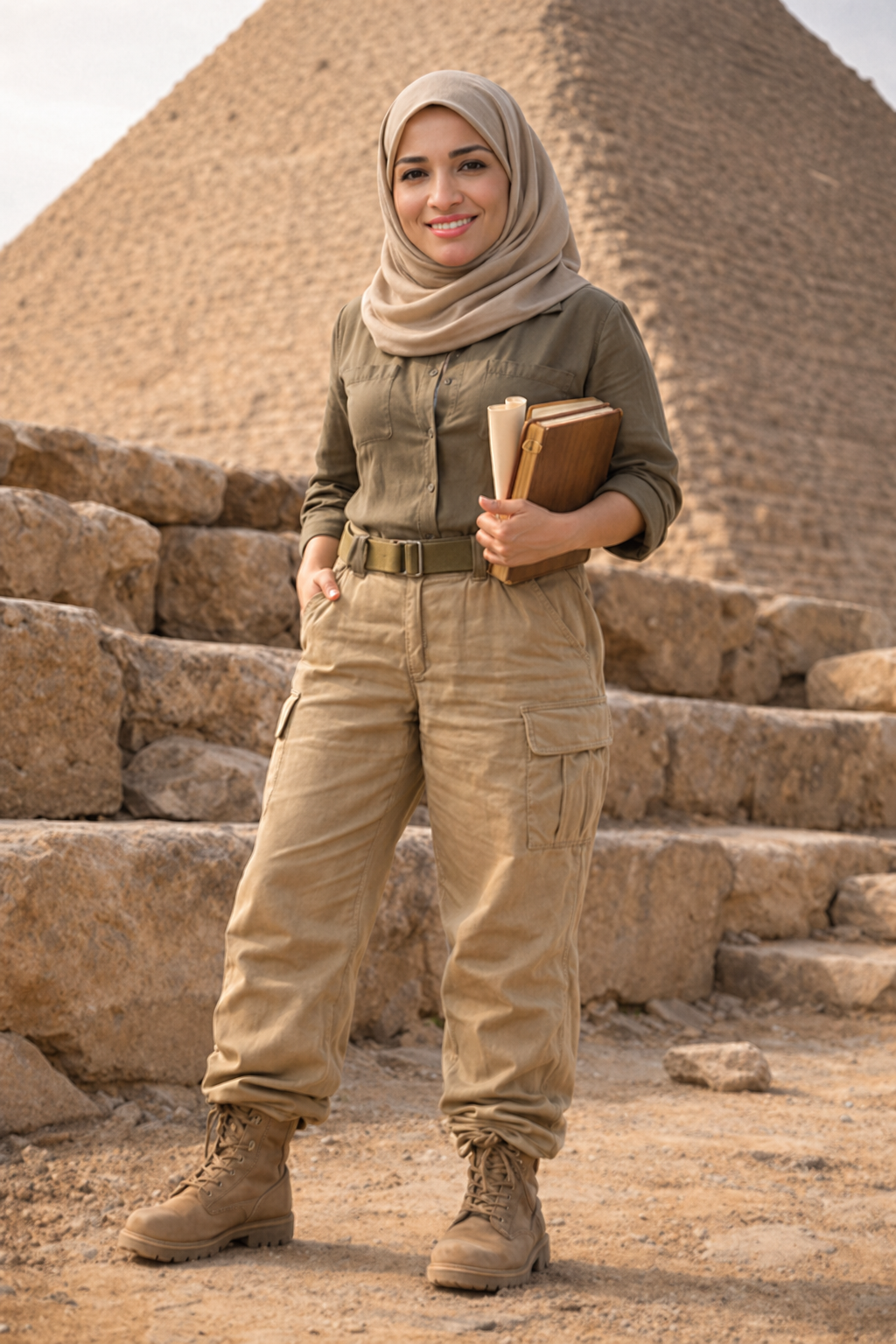
Armina El-Sayed
Dr. Armina El-Sayed is Head of Field Research and Site Integrity for the Supreme Council of Antiquities, where she oversees scientific monitoring and preservation efforts across Egypt’s most significant archaeological sites, including the Giza Plateau.
Born and raised in Cairo, Armina grew up in an environment shaped by both science and scholarship. Her father, a geologist, approached the Giza Plateau as a dynamic system rather than a static monument, mapping subsurface structures and theorizing about voids and internal formations long before such ideas were widely accepted. Her mother was an academic and lecturer, known for her clarity of thought and disciplined approach to historical interpretation. Together, they instilled in Armina a respect for evidence, structure, and intellectual independence.
She was educated at Cairo University, where she studied archaeology with a focus on ancient Egyptian structures and their physical properties. Early in her academic career, she distinguished herself by applying scientific measurement techniques to archaeological environments, combining traditional fieldwork with modern instrumentation. Rather than treating monuments as artifacts of the past, she approached them as systems that could still be observed, measured, and understood in the present.
Armina continued her postgraduate work in Egypt, specializing in site integrity, subsurface analysis, and the interaction between geological formations and constructed stone. Her work gradually expanded beyond conventional archaeology, incorporating seismic monitoring, infrasound detection, and resonance analysis within ancient structures.
Her professional role at the Supreme Council of Antiquities reflects that unique approach. She leads teams responsible not only for preservation but also for understanding how ancient sites behave under modern environmental conditions. At Giza, she has overseen the installation of sensors within and beneath the pyramids, tracking low-frequency vibrations, structural responses, and subtle shifts in the surrounding bedrock. Her work operates at the boundary between archaeology, geology, and physics.
Armina is known among her colleagues for her composure and precision under pressure. She is deliberate in her decisions, careful in her language, and resistant to speculation not supported by data. At the same time, she maintains a quiet openness to questions others might dismiss, a trait that has allowed her to pursue lines of inquiry outside conventional academic boundaries.
Her personal life has been shaped by both continuity and loss. Her late husband, Omar, was an architect whose work focused on structural form and historical design. His influence is still present in the way Armina understands space, proportion, and the relationship between built environments and the forces that act upon them. His death during a field incident early in her career left a lasting impact, reinforcing her discipline and deepening her commitment to her work.
Armina remains closely connected to her family’s legacy. The influence of her father’s geological perspective and her mother’s academic rigor continues to shape her thinking. She carries both forward in her work, combining measurement with interpretation in a way that reflects both traditions.
Her approach to science is grounded in observation and verification. She does not treat ancient structures as static relics, but as part of a larger system that can still be studied and understood. Where others see history, she sees function. Where others see permanence, she looks for change.
That perspective has made her one of the few researchers capable of recognizing when the behavior of those systems begins to shift.