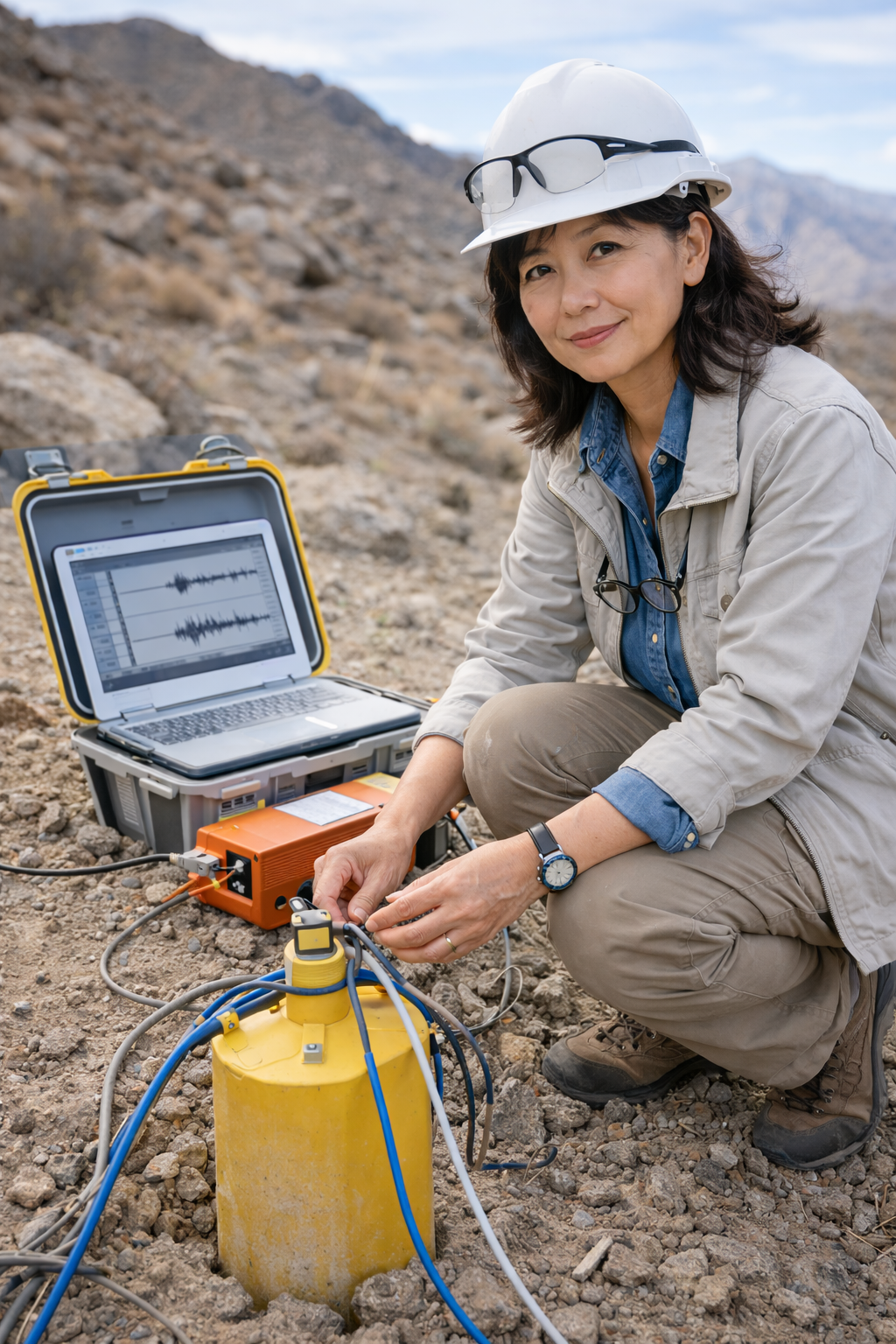
Hana Kuroda
Dr. Hana Kuroda is a seismologist based in Kyoto, Japan, where she specializes in the measurement and interpretation of low-frequency seismic activity and long-period ground motion. Her work focuses on identifying subtle patterns in the Earth’s behavior that often fall below the threshold of conventional detection.
Hana was born in Japan and raised in a family that valued discipline, education, and quiet observation. From an early age, she demonstrated a sensitivity to patterns others overlooked, particularly in natural systems that changed slowly over time. That inclination led her toward geophysics, where she found a field that rewarded patience, precision, and sustained attention to detail.
She pursued her academic training in Japan, completing her studies in seismology and geophysics before moving into advanced research focused on deep-earth signals and long-duration seismic waves. Her work distinguished itself early by focusing not on large, obvious events such as earthquakes, but on the continuous, low-level activity of the planet—signals that persist in the background and are often dismissed as noise.
Now based in Kyoto, Hana works in both academic and field environments, maintaining close proximity to active monitoring networks throughout the region. Japan’s tectonic complexity provides one of the most data-rich environments in the world, and Hana has built her career on extracting meaning from that constant stream of information. Her research emphasizes correlation across time and distance, identifying connections between seismic behavior that are not immediately apparent.
Hana is known among her colleagues for her precision and restraint. She speaks rarely in group settings, but when she does, it is with clarity and confidence grounded in data. She does not speculate, and she avoids conclusions until patterns have been confirmed across multiple observations. Her work often involves revisiting data others have already reviewed, finding structure where none was previously recognized.
She is married to a fellow seismologist, Kenji Kuroda, whose work focuses on tectonic stress modeling and earthquake prediction systems. Their professional lives frequently intersect, though their approaches differ. Where Kenji builds predictive models based on known variables, Hana focuses on identifying anomalies that fall outside those models. Together, they represent two complementary approaches to understanding the Earth’s behavior.
Their partnership extends beyond shared research. Both maintain a disciplined, methodical approach to their work, and their collaboration is grounded in mutual respect for evidence and process. While they often analyze the same data sets, Hana’s perspective has occasionally challenged assumptions within Kenji’s models, leading to deeper investigation and refinement.
Hana’s life in Kyoto reflects the same balance she brings to her work. The city’s blend of tradition and modernity mirrors her approach to science—respect for established knowledge combined with openness to new interpretation. She maintains a quiet, structured routine, dividing her time between research, field observation, and analysis.
Her expertise lies in detecting what others overlook. She is particularly skilled at identifying coherence within what appears to be random seismic activity, recognizing when signals align across systems in ways that cannot be explained by known geological processes.
Hana does not look for dramatic events. She looks for consistency.
And when the Earth begins to behave in ways that no longer fit established patterns, she is among the first to recognize that the change is real.