Axial Tilt (Obliquity)
The Earth does not stand upright as it moves through space.
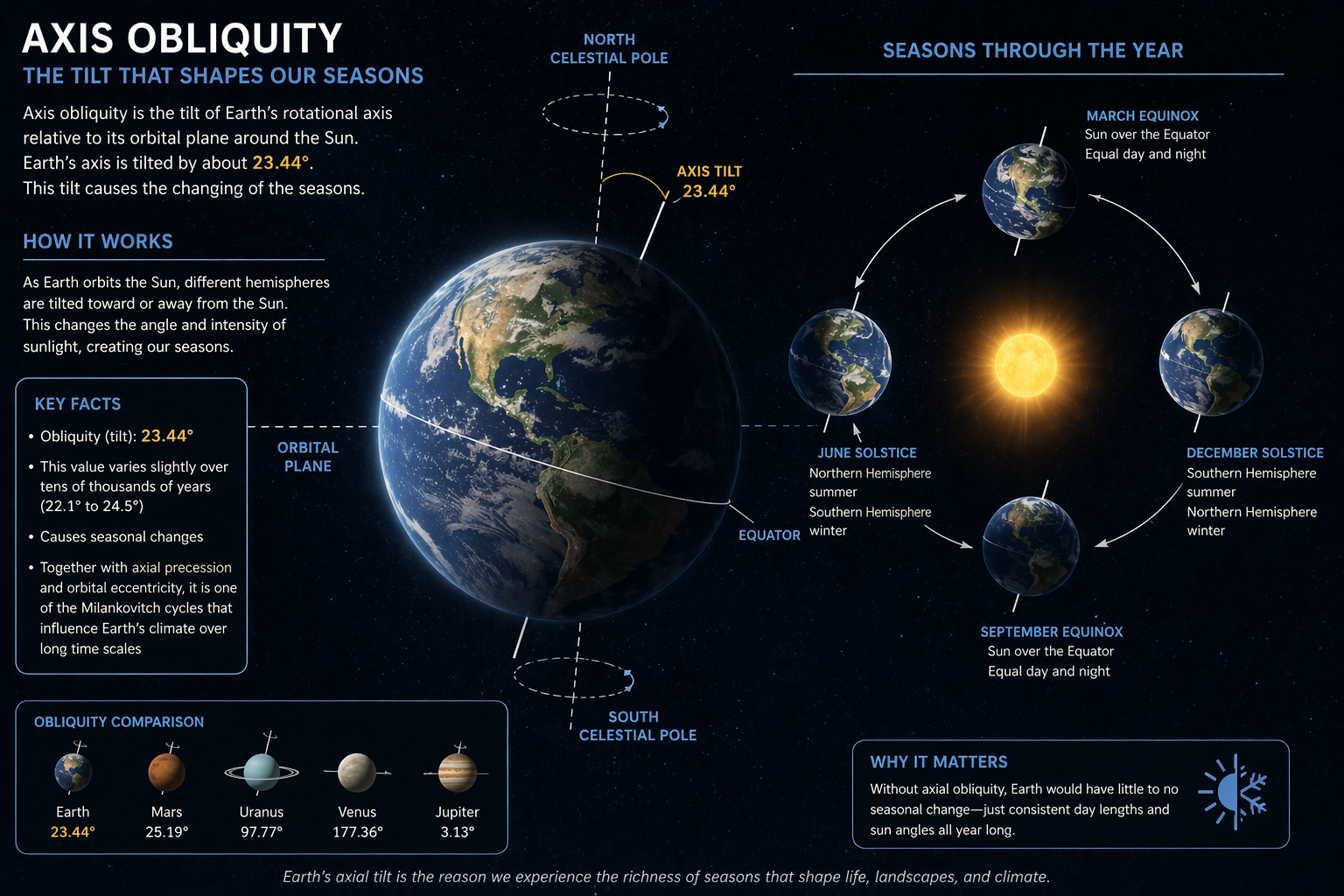
Its axis, the invisible line running from the North Pole to the South Pole, is tilted. Instead of being perpendicular to its orbit around the Sun, the Earth leans at an angle of approximately 23.4 degrees. This tilt, known as axial tilt or obliquity, is one of the most important factors shaping life on the planet.
Without it, the Earth would still rotate. It would still orbit the Sun. But it would not have seasons.
As the Earth travels around the Sun over the course of a year, the direction of its tilt remains essentially fixed in space. This means that for part of the year, the Northern Hemisphere is tilted toward the Sun, receiving more direct sunlight and longer days. At the same time, the Southern Hemisphere is tilted away, receiving less direct sunlight and shorter days. Six months later, the situation reverses.
This shifting exposure to sunlight creates the cycle of seasons.
When the Northern Hemisphere is tilted toward the Sun, it experiences summer. Sunlight strikes the surface at a steeper angle, concentrating energy and increasing temperatures. Days are longer, allowing more time for heating. In the Southern Hemisphere, winter occurs at the same time, with lower sun angles, shorter days, and reduced energy input.
At two points in the orbit, the tilt is neither toward nor away from the Sun. These are the equinoxes, when day and night are approximately equal across the planet. At the solstices, the tilt reaches its maximum effect, producing the longest and shortest days of the year.
The tilt itself is not perfectly constant. Over long periods, it varies slightly, shifting between about 22.1 and 24.5 degrees in a cycle that spans roughly 41,000 years. This variation is part of a larger set of orbital changes known as Milankovitch cycles, which influence long-term climate patterns on Earth.
When the tilt is greater, the seasons become more extreme. Summers are warmer, winters are colder, particularly in higher latitudes. When the tilt is smaller, seasonal differences are reduced, leading to milder transitions between summer and winter.
These changes do not occur on human timescales. They unfold slowly, over tens of thousands of years, influencing ice ages, glacial retreat, and shifts in climate zones across the planet.
In practical terms, axial tilt defines how energy from the Sun is distributed across the Earth. It determines where and when sunlight is concentrated, how heat is transferred through the atmosphere and oceans, and how ecosystems respond to changing conditions. It is one of the fundamental controls on the planet’s environmental balance.
Unlike precession, which changes the direction the axis points, axial tilt determines the angle itself. The two are related, but distinct. Precession reorients the axis. Tilt defines its inclination.
Together, they shape the long-term behavior of the Earth.
Axial tilt introduces contrast.
It creates difference between regions, between seasons, between extremes.
It is the reason the planet is not uniform.
The reason change is built into the system.
A fixed rotation would produce stability.
The tilt produces variation.