EARTH’S ROTATION
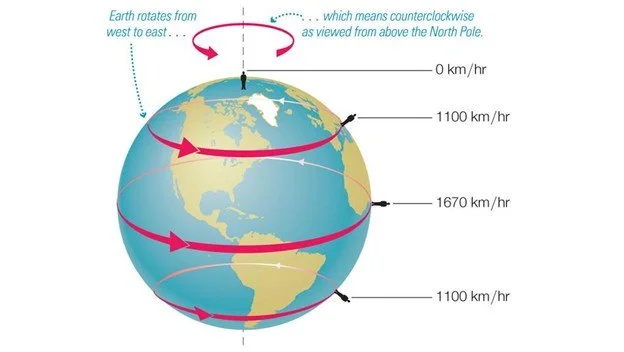
The Earth is always moving. Every twenty-four hours, it completes a full rotation on its axis, turning once from west to east. This motion creates the cycle of day and night, dividing the planet into light and darkness as it spins beneath the constant illumination of the Sun. It is the most immediate and familiar motion of the Earth, yet its implications extend far beyond the rising and setting of the sun.
At the equator, the surface of the Earth moves at approximately 1,040 miles per hour as it rotates. This speed decreases with latitude, reaching zero at the poles, where rotation occurs in place rather than across distance. The difference in speed between equatorial and polar regions contributes to atmospheric circulation patterns, influencing wind systems, ocean currents, and weather behavior across the globe.
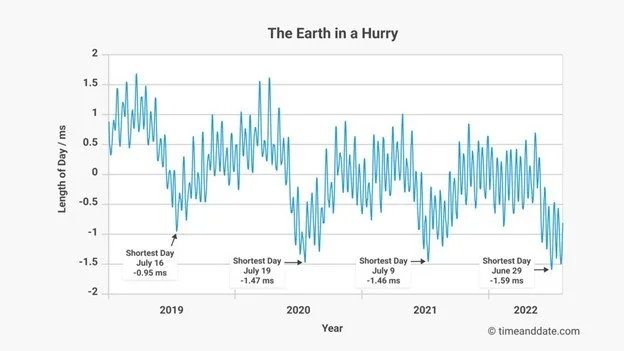
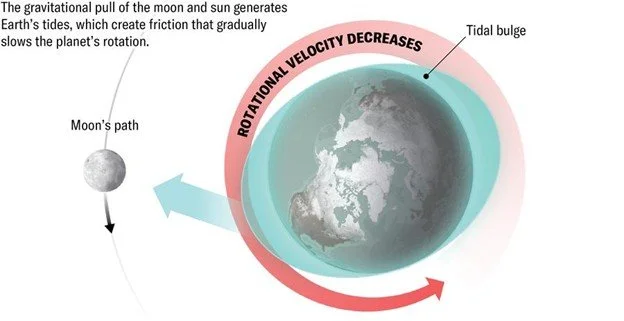
Despite its apparent constancy, Earth’s rotation is not perfectly uniform. The length of a day is not fixed at exactly twenty-four hours, but varies by small amounts measured in milliseconds. These variations are tracked using atomic clocks and expressed as changes in what is known as the length of day. Over time, the general trend is a gradual slowing of rotation, caused primarily by tidal friction from the gravitational interaction with the Moon.
As the Moon pulls on Earth’s oceans, it creates tidal bulges that are slightly offset from the line between the Earth and the Moon due to the planet’s rotation. This offset generates a torque that slowly transfers rotational energy from the Earth to the Moon, causing the Earth to spin more slowly while the Moon moves gradually farther away. The effect is small but measurable, increasing the length of the day by roughly 1.7 milliseconds per century.
Short-term variations in rotation speed occur as well. These are caused by changes in the distribution of mass within the Earth system. Large-scale atmospheric movements, ocean currents, and even seasonal shifts in water and ice can alter how mass is distributed across the planet, slightly accelerating or decelerating its rotation.
For example, strong winds in the atmosphere can transfer angular momentum between the air and the solid Earth, affecting rotation speed. Similarly, the melting or accumulation of ice at the poles changes how mass is distributed relative to the axis, influencing rotational behavior. Earthquakes can also produce minute adjustments, though their effects are typically very small.
Because modern systems rely on precise timing, even these tiny variations matter. When the difference between atomic time and Earth’s rotation becomes too large, leap seconds are added to keep them aligned. This ensures that our timekeeping remains consistent with the actual position of the Earth relative to the Sun.
From a physical standpoint, Earth’s rotation is a balance of forces. It is maintained by the conservation of angular momentum, influenced by gravitational interactions, and modified by internal and external dynamics. It is stable enough to support life as we know it, yet flexible enough to respond to changes within the system.
In a broader sense, rotation defines the rhythm of the planet.
It sets the pace of day and night.
It regulates cycles of temperature, weather, and biological activity.
It is constant enough to rely on,
but not so rigid that it cannot change.
Even the most fundamental motion of the Earth
is not fixed.