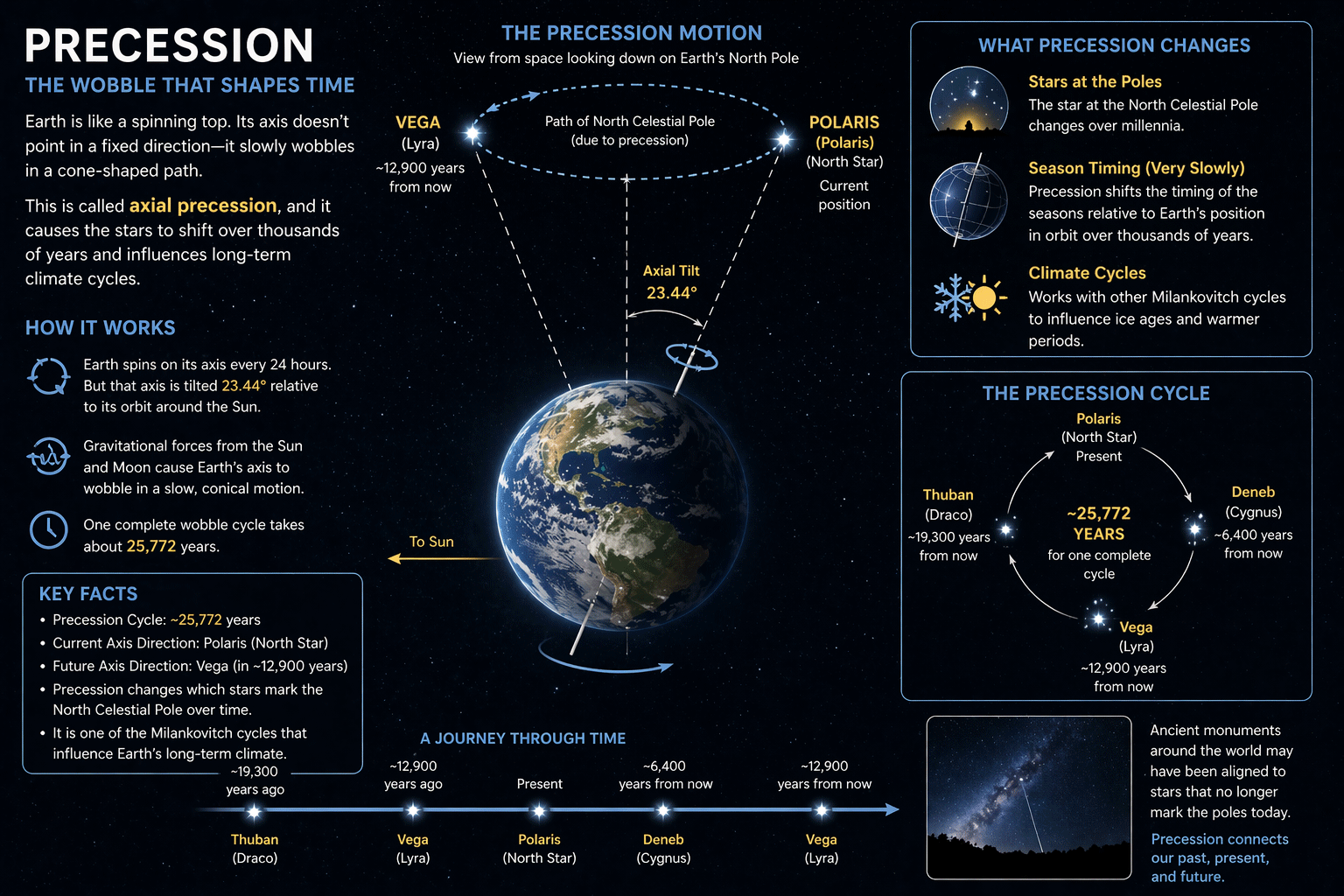
Axial Precession
The Earth does not spin in perfect stillness.
It rotates on its axis once every twenty-four hours, but that axis itself is not fixed. Over long periods of time, it slowly shifts, tracing out a circular motion in space. This movement is known as axial precession, a gradual wobble in the orientation of the planet’s rotation.
The motion is similar to the behavior of a spinning top. As the top rotates, its axis begins to circle, not because the spin stops, but because external forces act on it. The Earth behaves in much the same way, though on a vastly larger scale and over far longer periods.
The primary cause of this motion is gravitational influence. The Earth is not a perfect sphere. It bulges slightly at the equator due to its rotation. The gravitational pull of the Moon and the Sun acts on this equatorial bulge, creating a torque that slowly shifts the direction of the axis.
This shift is extremely slow. One complete cycle of precession takes approximately 26,000 years. Over that time, the axis traces a full circle, changing the direction in which it points relative to the background stars.
At present, the Earth’s axis points roughly toward Polaris, the North Star. Thousands of years ago, it pointed toward a different star. Thousands of years in the future, it will point elsewhere again. The stars themselves are not moving in this case. The reference frame is changing.
One of the most important consequences of precession is the slow shift of the equinoxes. The points in Earth’s orbit where day and night are equal, the spring and autumn equinoxes, do not remain fixed relative to the stars. Instead, they move gradually along the plane of Earth’s orbit, completing a full cycle over the same 26,000-year period. This is known as the precession of the equinoxes.
For ancient observers, this shift would have been almost imperceptible within a single lifetime, but detectable over generations. Star positions at specific times of year would slowly change. Constellations associated with seasons would drift. Over long periods, the entire framework of the night sky relative to the calendar would shift.
This has led to interpretations that some ancient structures may have been aligned not just to the sky as it appears now, but to the sky as it appeared thousands of years ago. Whether intentional or coincidental, the possibility introduces a time dimension to alignment, one that extends beyond a single moment and into long cycles.
Precession also affects the orientation of the Earth relative to the Sun, though it does not change the angle of the tilt itself in any significant way over short timescales. That tilt, currently about 23.4 degrees, is responsible for the seasons. Precession changes the direction the tilt points, not the amount of tilt. As a result, the timing of seasons relative to Earth’s position in its orbit shifts slowly over thousands of years.
From a physical standpoint, precession is a stable and predictable motion. It can be calculated, modeled, and projected far into the future. It is part of the Earth’s normal behavior, a background process that unfolds continuously whether observed or not.
And yet, like the Schumann resonance, it represents something larger than its immediate definition.
A slow movement that cannot be seen directly, only measured.
A change that occurs across generations, not moments.
A shifting reference that alters how everything else is positioned.
It does not disrupt the planet.
It reorients it.