The Schumann Resonance
The Schumann resonance is not a structure, not a place, and not something that can be seen. It is a phenomenon, a natural effect that exists continuously around the Earth, created by the interaction between the planet’s surface and the upper layers of its atmosphere.
To understand it, begin with the space between the ground and the sky.
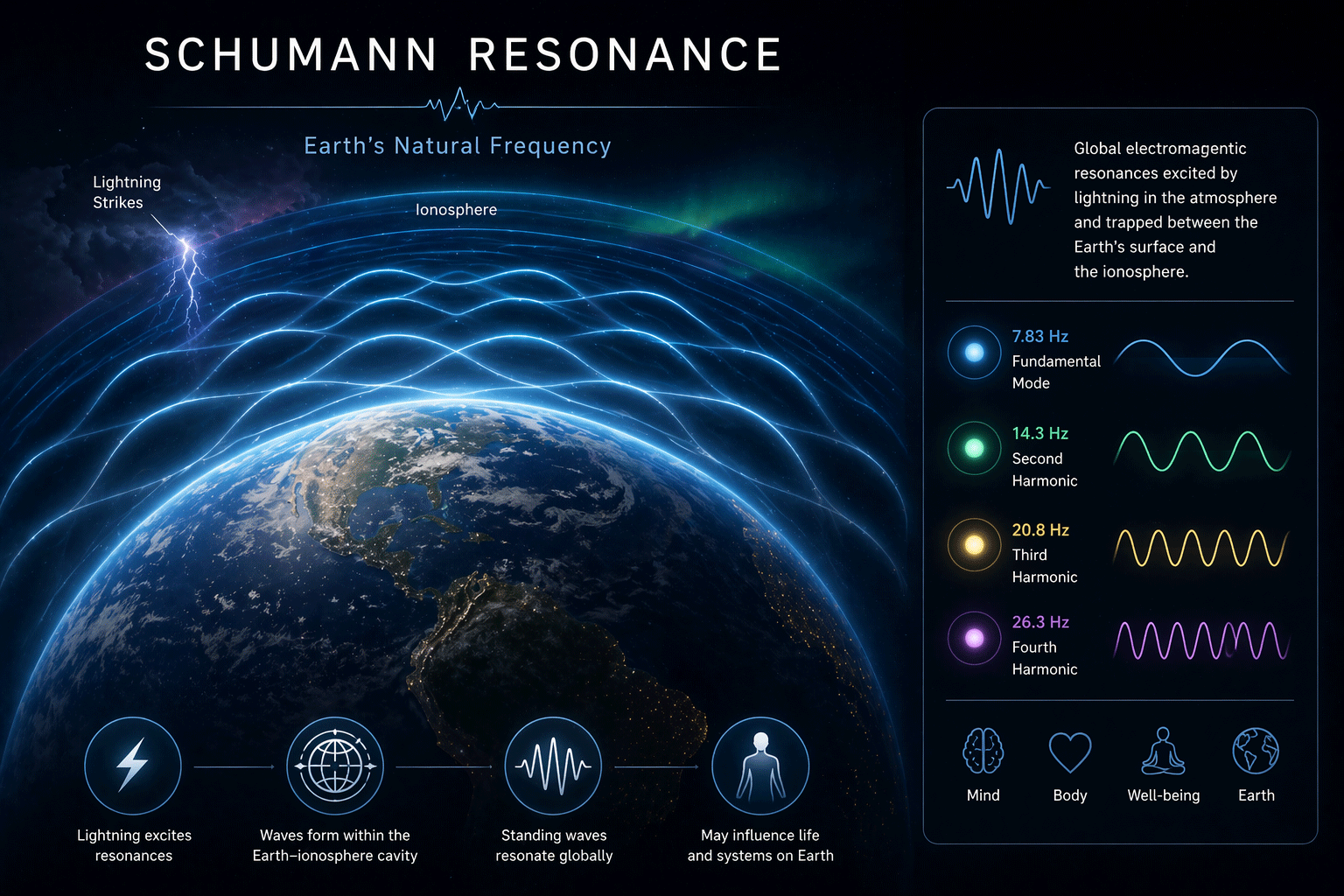
The Earth’s surface is electrically conductive. Above it, at an altitude of roughly 30 to 60 miles, lies the ionosphere, a region of the atmosphere charged by solar radiation. Between these two layers exists a global cavity, a boundary that encircles the planet. It is within this space that the Schumann resonance occurs.
Every second, lightning strikes the Earth somewhere on the planet. These strikes release bursts of electromagnetic energy that travel around the globe within this atmospheric cavity. Under the right conditions, these waves do not simply dissipate. They reinforce each other, forming standing waves that circle the Earth continuously.
The result is a set of natural frequencies, the lowest and most prominent of which is approximately 7.83 hertz. Additional harmonics appear at higher frequencies, typically around 14, 20, 26, and 33 hertz. These frequencies are extremely low, far below the range of most everyday electronic signals, and are classified as ELF, or extremely low frequency waves.
This phenomenon was first predicted mathematically by Winfried Otto Schumann in 1952 and later confirmed through measurement. It is now recognized as a persistent background signal of the planet, present at all times, though its strength varies depending on global lightning activity and atmospheric conditions.
The Schumann resonance does not exist in one location. It is global by definition. It is shaped by the size of the Earth, the height of the ionosphere, and the distribution of storms across the planet. Changes in any of these factors can alter the resonance slightly, shifting its frequency or intensity.
From a scientific standpoint, the Schumann resonance is well understood as a physical system. It is a byproduct of planetary scale electrical activity, measurable with sensitive instruments and modeled using established principles of electromagnetism. It does not require interpretation beyond physics to exist.
At the same time, its characteristics have led to broader interest.
The primary frequency, around 7.83 hertz, falls within the range of certain human brainwave patterns, particularly those associated with relaxed or meditative states. This overlap has prompted speculation about possible interactions between the resonance and biological systems. Some suggest that the Schumann resonance may act as a kind of environmental background rhythm, a constant signal present throughout human history.
There is no conclusive evidence that the resonance directly influences human behavior or physiology in a controlled or predictable way. However, the coincidence of frequency ranges has kept the question open, particularly in interdisciplinary studies that explore the relationship between environment and perception.
Another area of discussion involves the stability of the resonance itself. Because it depends on atmospheric conditions and solar activity, it is not perfectly constant. Solar storms, changes in the ionosphere, and large-scale atmospheric disturbances can all affect the resonance, sometimes measurably. These variations are typically small, but they demonstrate that the system is dynamic rather than fixed.
In practical terms, the Schumann resonance serves as a natural indicator of global electrical activity. It reflects the state of the atmosphere, the distribution of storms, and the condition of the Earth-ionosphere cavity. It is part of the planet’s baseline behavior, present whether observed or not.
In a broader context, it represents something else.
A continuous signal that encircles the planet.
A frequency that exists everywhere at once.
A system defined not by a single source, but by the interaction of many.
It is not a message.
It is not directed.
It does not originate from a single point.
And yet, it is always there.