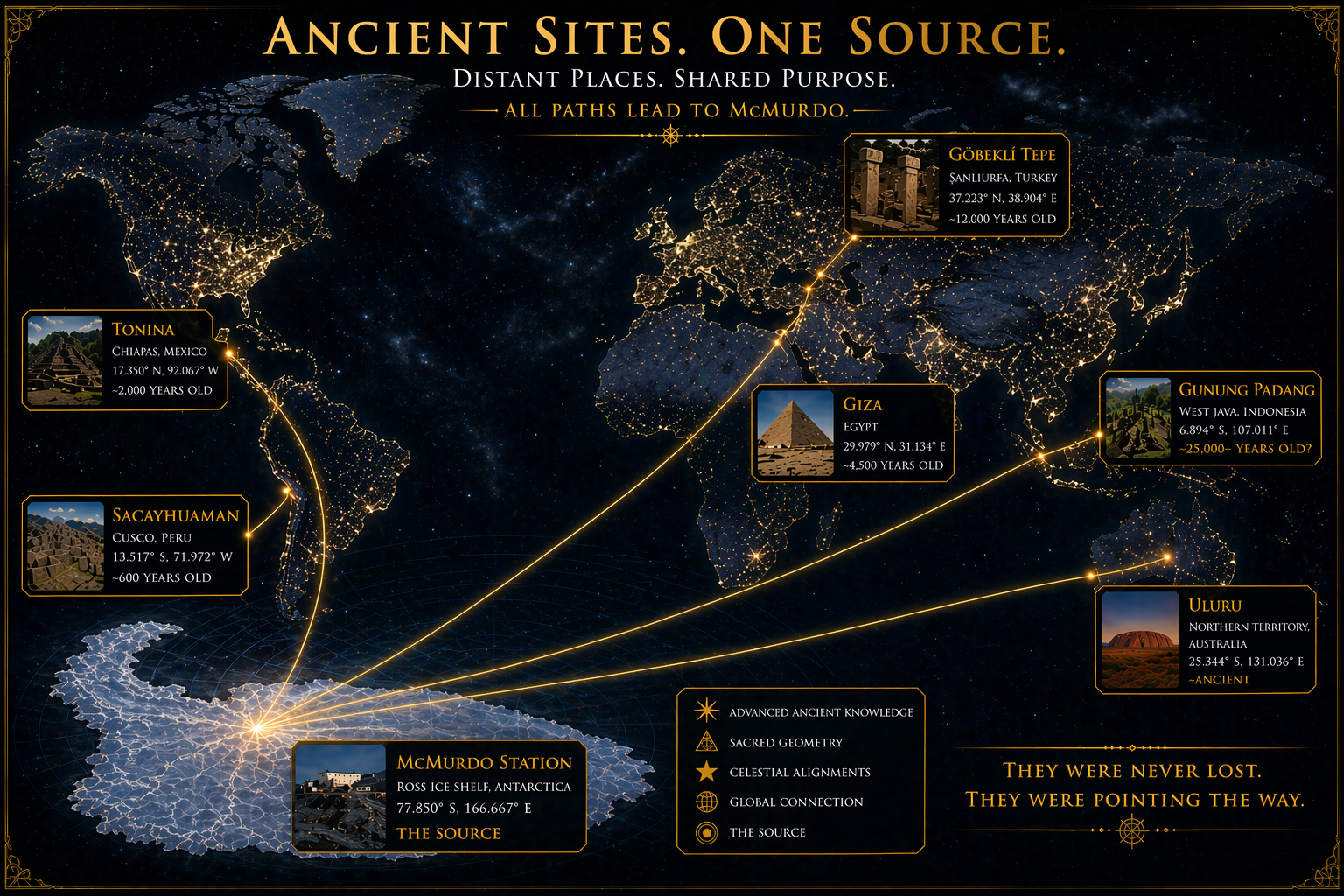
Seven Nodes
In The Source, the seven nodes are not symbolic locations or loosely connected sites. They are a distributed stabilization system, built across the planet to maintain balance within a dynamic and increasingly unstable Earth system. Each node exists at a point where geology, geometry, and long-term stability intersect. Individually, they do not control the planet. Together, they define a reference framework that allows the planet to remain within tolerable limits of variation.
The core problem they address is not a single failure, but a condition of drift.
The Earth is not static. Its axis shifts through precession. Its tilt changes over long cycles. Its rotation speed varies in response to internal and external forces. Its magnetic field fluctuates. These are natural processes, but in The Source, they are no longer remaining within stable bounds. The system is moving too quickly, and the natural damping mechanisms that once absorbed these changes are no longer sufficient. The seven nodes exist to provide that damping.
Each node is anchored to a geologically stable foundation, a point where the underlying structure of the Earth has remained consistent over immense spans of time. These locations were not chosen for visibility or convenience. They were selected because they do not move in ways that matter at planetary scale. They provide fixed reference points in a system that is otherwise in motion.
But stability alone is not enough.
Each node also interacts with the planet’s natural resonance environment. The Earth constantly produces low-frequency electromagnetic and vibrational signals, including the background field described as the Schumann resonance. In The Source, the nodes are designed to engage with these signals, not by generating energy, but by responding to it. They function as resonant structures.
Their internal geometry, material composition, and spatial relationships allow them to detect phase, the timing and alignment of oscillatory systems across the planet. When the system is stable, the signals align within expected ranges. When instability begins, those signals drift out of phase. The nodes detect this misalignment. Detection is only the first step.
The nodes do not correct the system by force. They correct it by coherence.
Each node acts as a phase reference. When a deviation occurs, the nodes reinforce the correct phase relationship through resonance. This is similar to how coupled oscillators behave in physics. When multiple oscillating systems are connected, even weakly, they tend to synchronize over time. The nodes accelerate that process, guiding the planet’s systems back into alignment.
The effect is subtle but cumulative.
A single node cannot stabilize the system. It can only reflect it. But when multiple nodes operate together, they create a distributed network that defines a coherent global phase. The system does not need to be forced back into position. It is drawn back into alignment through interaction with these reference points.
The seventh node plays a distinct role.
While the other nodes form a distributed network, the seventh acts as a closure point. It completes the geometric and resonant structure, allowing the system to function as a whole. Without it, the network remains open, capable of detecting instability but unable to fully resolve it. When the seventh node is active, the system becomes closed and self-reinforcing.
At the center of this network lies Harmonic Zero.
Unlike the other nodes, Harmonic Zero does not operate as part of the distributed system. It exists as the primary reference, the point against which all other nodes are ultimately aligned. It is not subject to the same variations as the surface sites. It is anchored to a deeper level of stability, providing a baseline that does not drift.
The seven nodes translate that baseline into the planetary system.
They do not transmit instructions. They establish alignment.
They do not generate energy. They regulate phase.
They do not override natural processes. They guide them back within stable bounds.
In earlier civilizations, this system functioned passively. The nodes were sufficient to maintain stability because the rate of change within the Earth system remained slow. Natural variations occurred, but they did not exceed the capacity of the network to absorb and correct them. That condition no longer exists.
In The Source, modern activity, environmental disruption, and accelerating planetary changes have pushed the system beyond the threshold where passive stabilization is enough. The nodes still function, but they require a coherent reference to synchronize against. Without that reference, they detect instability but cannot fully resolve it.
That is where the Listener becomes necessary. The Listener does not control the nodes. The Listener provides coherence.
By phase-locking with the planetary resonance, the Listener introduces a stable oscillatory pattern into the system, one that the nodes can recognize and amplify. The nodes then propagate that coherence across the network, restoring alignment at a global scale.
It is not a command structure.
It is a synchronization event.
The system stabilizes not because it is forced to,
but because it remembers how.