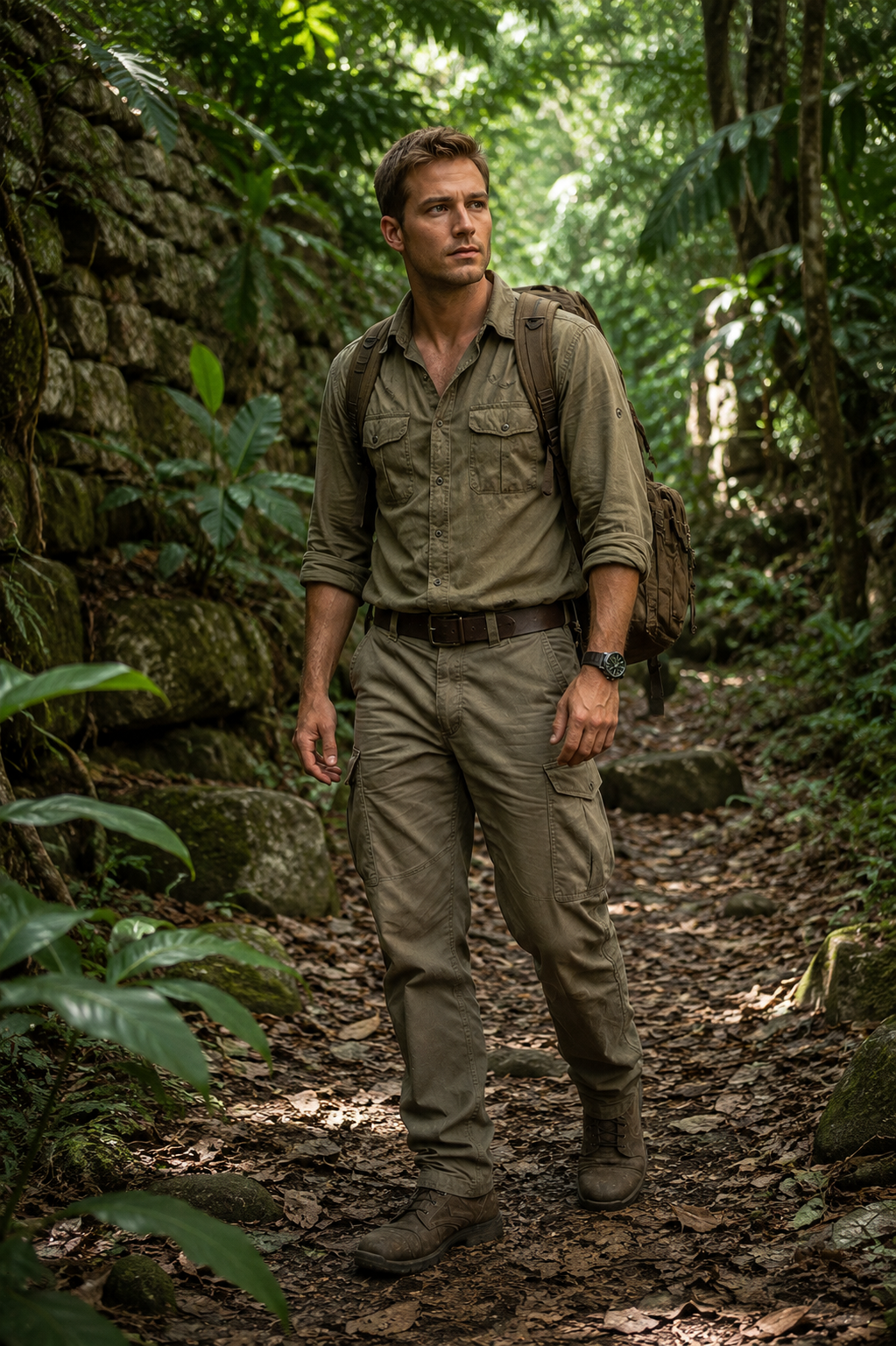
Chris Whiting
Chris Whiting is a gifted young archaeologist whose work focuses on archaeological acoustics, the study of how ancient structures interact with sound, vibration, and resonance. He earned both his undergraduate and master’s degrees at the University of Chicago in an unusually short period of time and worked with the Institute for the Study of Ancient Cultures before accepting a research assistantship with the Middle American Research Institute in New Orleans. The position allowed him to continue doctoral work while gaining the field experience he had been looking for.
Chris grew up in Maryland with his mother, Elise, carrying the legacy of a family shaped by loss. His father died before Chris had the chance to know him, and his grandmother, scientist Christina Whiting, disappeared under mysterious circumstances when he was young. Those absences contributed to a seriousness that often made Chris seem older than his years. He became highly self-reliant, academically driven, and more comfortable with research and ideas than with casual social situations.
His grandmother had a particularly strong influence on him. Although Chris knew Christina largely through family stories, photographs, and fragments of her scientific work, he became fascinated by the questions she left behind. At age twelve, he received an unusual stone from one of her former colleagues in Egypt, an event that deepened his interest in ancient cultures, scientific anomalies, and the possibility that archaeological sites might preserve forms of knowledge modern science had overlooked.
Intellectually, Chris is precise, analytical, and skeptical by nature. He is not easily persuaded by extraordinary claims, but he is equally unwilling to dismiss evidence simply because it does not fit accepted theory. That balance is one of his strongest qualities. He prefers to model, measure, compare, and test rather than speculate.
His specialty developed at the intersection of archaeology, physics, and digital modeling. Rather than viewing ancient monuments simply as ceremonial or cultural objects, Chris became interested in whether their geometry and materials might have been deliberately designed to produce measurable physical effects. Dr. Deanna Ortega recognized that unusual approach when she recruited him to MARI, describing his modeling work as especially well suited to the Institute’s research.
Personally, Chris tends to be reserved, literal, and occasionally overly formal. His insistence on being called a “research assistant” rather than an intern reflects both his seriousness and a small streak of youthful pride. His colleagues often tease him for it. Beneath that formality, however, he has a dry sense of humor and a strong capacity for loyalty.
Chris is also deeply compassionate, although he does not always express emotion easily. He forms close attachments slowly, but once he trusts someone, he is intensely protective of them. His relationship with Maria Valdez is especially important because she becomes his first real love and one of the few people who draws him out of his guarded, highly analytical world.
Physically, Chris is fit rather than imposing, more accustomed to fieldwork, hiking, and carrying equipment than to formal athletics. He is comfortable in difficult environments and adapts quickly once he has a problem to solve. He tends to dress practically, favors field clothes and boots, and carries himself with the focused manner of someone who is almost always thinking about something several steps ahead.
What defines Chris most is curiosity disciplined by evidence. He inherited questions from his grandmother, but he does not simply follow her path. He is building his own, combining archaeology, acoustics, physics, and systems thinking in ways few people his age have attempted.
He is serious, intelligent, loyal, occasionally awkward, and far more resilient than he initially appears.