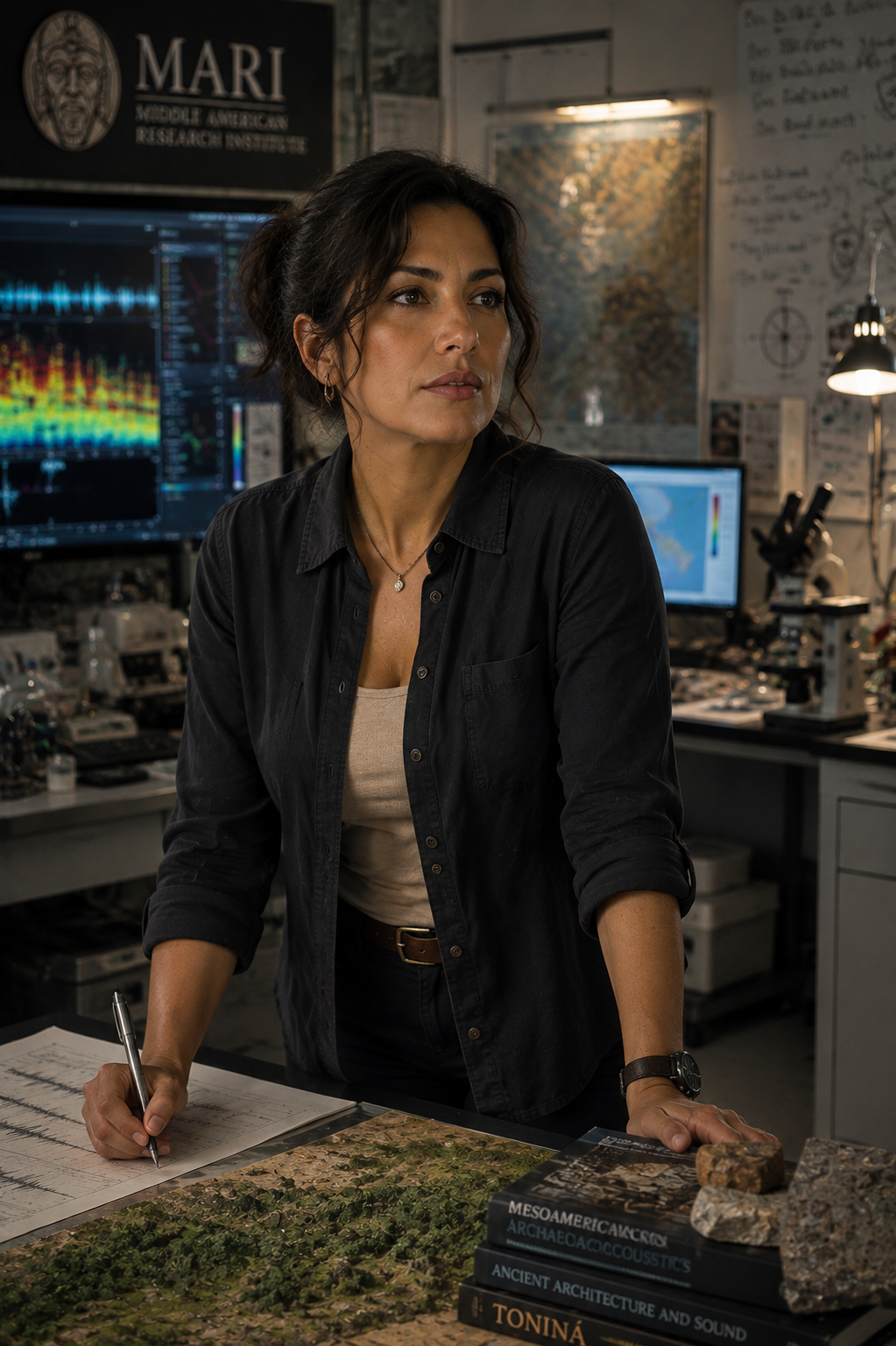
Dr. Deanna Ortega
Director, Cultural Acoustics and Symbolic Architecture
Middle American Research Institute (MARI)
Dr. Deanna Ortega came to archaeology later in life, bringing with her an understanding of culture that had been formed long before she entered a university classroom.
Raised in Southern California’s Inland Empire, Deanna grew up in a Mexican American community where English and Spanish, old traditions and modern California life existed comfortably beside one another. Her parents considered themselves American and spoke little about the generations that came before them. Yet Deanna grew up surrounded by reminders of that heritage, in neighborhood murals, family traditions, music, food, and the stories embedded in everyday life.
She married young and raised two children, putting family ahead of the intellectual curiosity that had always been part of her life. That changed in her late thirties. Her marriage ended, her youngest child left for college, and the death of her father forced Deanna to reconsider the direction of her life. While sorting through his belongings, she discovered an old photograph of a temple in Oaxaca. On the back, her father had written four words: “Our people built this.”
Those words redirected her life.
Deanna began studying Mesoamerican history and archaeology on her own before auditing courses at UCLA. She eventually enrolled formally and attacked her education with the intensity of someone who felt she had already lost too much time, completing her bachelor’s and master’s degrees in half the normal period. She went on to earn a doctorate at UCLA, writing her dissertation on symbolic architecture in Classic-period Mesoamerica and examining the ways temples and ceremonial structures preserved cultural memory and belief.
Her academic interests gradually moved beyond conventional archaeology. Deanna became particularly interested in the relationship between architecture, sound, mathematics, astronomy, and ritual. She questioned whether the acoustic characteristics of ancient structures were incidental consequences of their construction or deliberate elements of their design.
After completing her doctorate, she remained at UCLA as an adjunct professor, teaching Mesoamerican civilizations, ancient American cities, and archaeological field methods. A visiting Tulane researcher heard her speak at a museum event about the possibility that stone architecture could preserve cultural information and that sound might have been deliberately incorporated into ancient structures. He invited her to work with the Middle American Research Institute in New Orleans. What was supposed to be a six-month fellowship became the defining professional relationship of her career.
At MARI, Deanna quickly established herself as someone capable of bridging disciplines that rarely communicated effectively with one another. Archaeological evidence, satellite imagery, acoustics, geology, cultural traditions, and historical records were not separate subjects to her. They were different forms of evidence describing the same ancient world.
Within two years, she had become one of MARI's principal field coordinators. She was eventually appointed Director of Cultural Acoustics and Symbolic Architecture, a position that placed her at the center of the Institute's investigations into the unusual acoustic and structural properties of Mesoamerican sites.
Her research increasingly focused on Toniná, Chichén Itzá, Palenque, Teotihuacán and other sites where chambers, terraces, stairways and plazas appeared capable of amplifying or sustaining particular frequencies. Deanna became convinced that some ancient builders understood relationships among sound, stone and the Earth itself that modern archaeology had overlooked.
That willingness to cross disciplinary boundaries eventually brought her research into contact with the work of Christina Whiting. Although Deanna never knew Whiting personally, she was familiar with her studies of atmospheric magnetic behavior and resonance instability. Whiting's research helped validate some of MARI's early models involving acoustic propagation and electromagnetic responses at archaeological sites.
Deanna is a scholar, but she is also a field archaeologist and administrator accustomed to making decisions when evidence is incomplete. She is methodical without being rigid, skeptical without being dismissive, and willing to entertain extraordinary explanations only after ordinary ones have been exhausted. Her authority comes less from title than from experience. She has little patience for academic territorialism and even less for anyone who allows ambition to take precedence over evidence or preservation.
For Deanna, the discovery is more than an archaeological revelation. It completes a journey that began decades earlier with a faded photograph found among her father's belongings. She entered archaeology searching for an understanding of the people who built the ancient cities of Mesoamerica. What she discovers is that understanding the past may be essential to protecting the future.