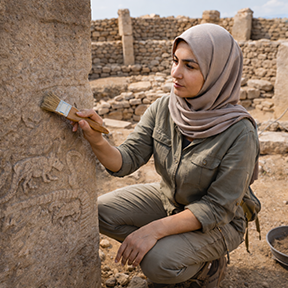
Leyla Karahan
Dr. Leyla Karahan is an archaeologist based in southeastern Turkey, where she specializes in Neolithic sites and early human settlement structures, with a primary focus on Göbekli Tepe. Her work centers on the study of some of the oldest known constructed environments on Earth, examining how early societies organized space, built in stone, and interacted with their surrounding landscape.
Leyla was born in Turkey and raised with a strong connection to both history and place. From an early age, she was drawn to questions about the origins of civilization, particularly how the first large-scale structures were conceived and built long before the development of cities or written language. That curiosity led her into archaeology, where she focused on the earliest phases of human construction.
She completed her academic training in Turkey, specializing in archaeology with an emphasis on Neolithic cultures of the Near East. Her studies concentrated on early monumental architecture and the physical methods used to construct and maintain large stone structures. She developed a reputation for disciplined fieldwork and careful interpretation, grounded in measurable evidence rather than speculation.
Leyla’s professional work is closely tied to Göbekli Tepe, a site that has reshaped modern understanding of early human societies. The massive stone pillars and circular enclosures found there predate previously known organized construction by thousands of years. Her research focuses on the physical properties of these structures, their placement within the terrain, and the techniques used to shape and position the stone.
Her approach emphasizes direct observation and measurement. She studies tool marks, stone composition, alignment, and spatial relationships between structures, seeking to understand how the site was engineered and how it functioned within its environment. She is particularly interested in how early builders achieved consistency and precision without the technological frameworks assumed necessary for such work.
Leyla is known among her peers for her focus and independence. She prefers working in the field, often spending extended periods at excavation sites where she can study the structures directly. Her communication style is direct and measured, and she avoids conclusions that extend beyond what can be supported by evidence.
Outside of her work, Leyla maintains a relationship with a professional footballer who plays in Turkey’s top league. His career places him in a very different world—public, fast-moving, and highly visible—while Leyla’s remains quiet, deliberate, and largely unseen. The contrast between their lives is significant, but it provides balance. His presence offers a connection to a broader, more immediate world, while her work remains rooted in deep time and careful study.
Despite the differences, the relationship is grounded in mutual respect. He understands the demands of her fieldwork and long absences at remote sites, while she respects the discipline and performance required at the highest level of sport. They occupy different spheres, but neither tries to change the other.
Leyla’s life reflects the same structure she brings to her work. She is disciplined, focused, and grounded in evidence, yet aware that not everything meaningful is immediately understood.
Her strength lies in recognizing structure where others see fragments, and in understanding how early systems of construction relate to one another across time.
She does not assume intention.
She looks for evidence of it.