Marisol Vega
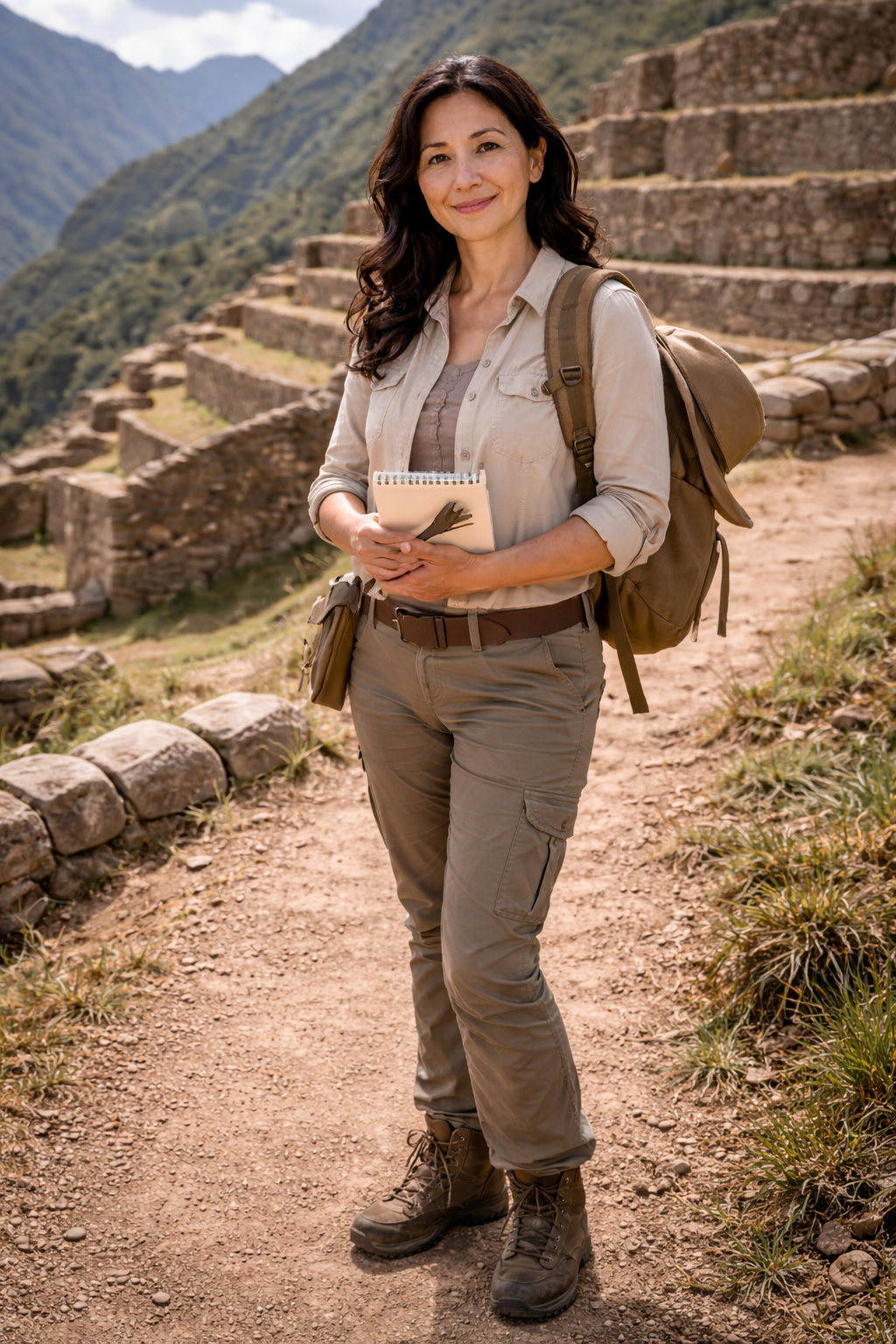
Dr. Marisol Vargas is an archaeologist and field researcher based in Cusco, Peru, where she specializes in pre-Columbian Andean civilizations and high-altitude stone architecture. Her work focuses on the structural and geographic relationships between ancient sites across the Andes, with particular attention to how those sites were positioned within the surrounding landscape.
Marisol was born in Peru and raised in the Andean highlands, where the presence of ancient stonework is not abstract history but part of the living environment. From an early age, she developed a familiarity with the terrain, the altitude, and the physical reality of sites that many only encounter through study. That background shaped her perspective, grounding her work in direct experience rather than theory alone.
She pursued her formal education in archaeology in Peru before continuing advanced study in South American pre-Columbian cultures, focusing on Inca and pre-Inca construction techniques. Her academic work emphasized field-based research, and she quickly established a reputation for her ability to work in remote and physically demanding environments.
Marisol’s research centers on sites such as Sacsayhuamán, Ollantaytambo, and Machu Picchu, where massive stone structures were constructed with a level of precision that continues to challenge modern understanding. Rather than focusing solely on cultural or ceremonial interpretations, she examines how these sites were engineered, how they interact with the terrain, and how they relate to one another across large distances.
Her work often involves detailed mapping of stone placement, alignment, and structural integration with the surrounding mountains. She studies how walls, terraces, and foundations respond to environmental forces such as seismic activity, erosion, and long-term geological change. This approach places her at the intersection of archaeology, geology, and engineering.
Marisol is known for her independence and resilience in the field. She is comfortable working in isolated locations at high altitude, where conditions are unpredictable and access is limited. Her ability to operate under those conditions has made her a key figure in research efforts that require sustained presence in remote regions.
Among her colleagues, she is recognized for her practical approach and direct communication style. She places a high value on observable evidence and is cautious about interpretations that extend beyond what can be physically confirmed. At the same time, she is open to reexamining long-held assumptions when new data challenges established views.
Her connection to the Andes is both professional and personal. The landscape is not simply a subject of study but a defining part of her identity. She understands the terrain not only through measurement, but through lived experience, an awareness that informs how she interprets the sites she studies.
Marisol’s work reflects a broader perspective on ancient construction. She does not view these sites as isolated achievements, but as part of a larger network shaped by geography, environment, and intent. Her research continues to explore how these structures relate to one another across the region, and what that relationship reveals about the people who built them.
Her strength lies in recognizing patterns across distance, identifying connections between sites that are separated by terrain but linked through design and placement.
She does not assume those connections.
She proves them.