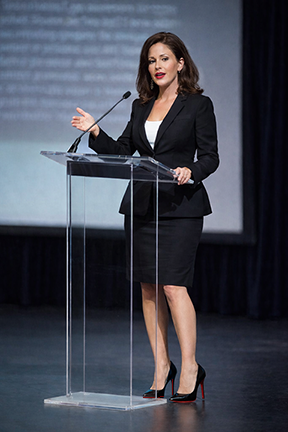
Dr. Christina Whiting
Dr. Christina Whiting is a geospace dynamics specialist at NASA Goddard Space Flight Center, where she focuses on the precise measurement of the Earth’s position, rotation, and orientation in space. Her work supports mission planning and orbital accuracy, ensuring that spacecraft are launched and inserted into trajectory with exact timing and alignment.
She was born and raised in northern New Mexico, just outside Santa Fe, where the horizon feels infinite and the night sky is a living map. The desert shaped her early. Her father worked in regional water resource management, studying aquifers and seasonal runoff. Her mother taught physics at a local high school. Evenings were often spent on the flat roof of their adobe home watching meteor showers sweep across the high desert sky.
Christina’s relationship with strength began early. Her father died when she was still young, old enough to remember his voice but not old enough to understand why it disappeared. His absence reshaped the household overnight. The desert felt larger after he was gone. It was her mother who held everything together. She continued teaching physics during the day and grading papers late into the night, never allowing grief to loosen the structure of their lives.
She and her mother grew inseparable in those years. Evenings on the adobe roof became their ritual. They studied constellations, argued gently about equations, and talked about responsibility in a way that made science feel both rigorous and personal. Her mother did not shield her from hardship; she taught her how to stand inside it. When money was tight, they adjusted. When loneliness crept in, they filled it with purpose. Christina learned that resilience was not loud. It was steady.
Losing her father gave her an early understanding of the fragility of life. Being raised by her mother gave her an example of controlled strength. The combination shaped her permanently. It is why she appears composed in crisis, why she does not collapse when systems fail, and why she holds loyalty so fiercely. Beneath the disciplined scientist is the daughter of a woman who refused to let loss define her child’s future.
When Christina’s mother suddenly died upon her graduation from High School, she converted the money from her mom’s life insurance and the sale of the New Mexico home into her education.
Christina earned her undergraduate degree in Earth and Planetary Sciences at San Diego State University, where she gravitated toward geomagnetism and planetary resonance systems. She majored in geology and was fascinated by electromagnetic signatures, rotational drift, background frequencies that most people never notice. She completed her PhD at Stanford University, focusing on magnetospheric dynamics and Earth orientation parameters. Her work examined how solar activity interacts with Earth’s magnetic field and how small shifts in axial alignment influence satellite navigation and orbital precision.
Her early research earned her the American Geophysical Union’s James B. Macelwane Medal nomination for emerging scientists and later a NASA Exceptional Scientific Achievement Medal for her contributions to pre-launch Earth orientation modeling.
At Goddard, Christina became known for her role in pre-launch positional analysis. She calculates where Earth is in space at the precise moment a rocket leaves the pad. Her work integrates polar motion, axial tilt, gravitational irregularities, atmospheric behavior, and rotational timing. Spaceflight, as she often says, is a timing problem first and a propulsion problem second. Her models have supported dozens of successful launches, both crewed and uncrewed.
Colleagues describe her as exacting. She is calm in meetings, rarely raises her voice, and does not indulge speculation without evidence. Yet she is not rigid. Christina is deeply grounded in science, but she understands its boundaries. When data resists explanation, she does not retreat into denial. She asks better questions. She believes that unexplained phenomena are invitations to refine understanding, not threats to credibility.
Over the course of her career, she has received multiple NASA Group Achievement Awards for mission support and has been recognized internally for operational excellence during high-risk launch windows. She does not display the plaques prominently. They are stacked neatly in a cabinet in her office.
Christina’s reputation for precision sometimes overshadows another defining trait: she is unusually creative. Not flamboyant, not reckless, but inventive in ways that make traditional thinkers uncomfortable. She explores angles others dismiss too quickly. When a dataset refuses to cooperate, she does not simply rerun the model. She redesigns the question. She has been known to combine disciplines that rarely share a conference stage, to pull atmospheric science into orbital mechanics, to borrow signal-processing techniques from fields far outside aerospace.
Her creativity extends beyond research. She questions processes that exist only because “that’s how it’s always been done.” She has reorganized workflows, built informal cross-division collaborations, and pushed for transparency in places where bureaucracy preferred silence. She believes that good science and good governance require moral clarity. If a shortcut compromises integrity, she will not take it. If a decision sacrifices long-term stability for short-term optics, she will challenge it.
That combination of creativity, morality, and relentless work ethic has not always made her popular with superiors. Christina will outprepare, outthink, and outwork almost anyone in the room. She reads the background material others skim. She anticipates objections before they are spoken. When she believes she is right, she does not bend easily. There have been moments when her refusal to soften conclusions or dilute findings placed her at odds with leadership that preferred comfort over candor.
Some managers saw her as difficult. The wiser ones recognized what she truly is: a rare asset. A scientist who not only understands systems deeply but is willing to protect them at personal cost. A person whose integrity is not situational. A mind that sees possibilities others never consider and has the discipline to pursue them without losing grounding. In organizations that depend on precision and trust, that combination is not common. It is a treasure.
Personally, Christina carries a quiet resilience shaped by loss.
She married Bill in her thirties. He was thoughtful, grounded, and deeply supportive of her demanding career. His death from cancer came far too early, leaving Christina to raise their daughter, Elise, alone. Bill’s absence changed her, but it did not harden her. If anything, it sharpened her sense of responsibility.
Christina’s strength revealed itself most clearly in the years after Bill’s death. Raising Elise alone while building a demanding scientific career required discipline that bordered on relentless. She structured her days with military precision, balancing late nights at the lab with early mornings packing lunches and reviewing homework.
When Elise developed a series of unexplained childhood illnesses that left doctors uncertain and treatments inconsistent, Christina refused to accept vague answers. She read medical journals the way she read satellite data, cross-referenced symptoms, tracked patterns in notebooks, and sought second and third opinions without apology. Where physicians saw isolated episodes, she saw trends. Where they hesitated, she pushed. Her persistence led to specialists who finally identified the underlying issues and stabilized Elise’s health. She never dramatized those years. She simply did what was required. The same analytical rigor she applied to planetary systems, she applied to protecting her daughter. Beneath her composed exterior is a woman who will quietly outwork, outlast, and outthink any obstacle when the people she loves are at stake.
Years later, history echoed through the next generation. Elise fell in love with Rob, a decorated Marine with a steady presence and dry humor. Rob deployed overseas before Elise even realized she was pregnant. He was killed in combat before they had the chance to marry, before he knew he would become a father. Christopher was born into a family already familiar with absence.
She has become a constant presence in her grandson Chris’s life.
Christina lives in a modest home near Rock Creek Park in Washington, D.C. She keeps her kitchen simple, her workbench organized, and her data archived meticulously. She still tinkers with old radios in her spare time, a habit from childhood.
Although she rarely discusses personality frameworks publicly, Christina once took a professional assessment out of curiosity and read the results more carefully than she admits. The profile described someone intuitive yet analytical, private yet deeply idealistic, driven by meaning as much as by measurement.
It helps her understand why she feels the weight of responsibility so strongly, why she instinctively looks for patterns beneath surface noise, and why she remains open to questions that sit just beyond what current science can fully explain. She does not rely on the profile to define her, but she keeps it tucked away as a personal shorthand, a way to remind herself that discipline and sensitivity can coexist, and that the tension she feels between logic and intuition is not weakness but design.
At 62, Christina Ann Whiting is both sensitive and formidable. She listens carefully, thinks deeply, and speaks with precision. She has endured loss without surrendering warmth, built a career on exactitude without losing curiosity, and raised a family defined not by what was taken from them, but by what remains steady.
She believes the universe hums more often than it shouts. And she has spent her life learning how to listen