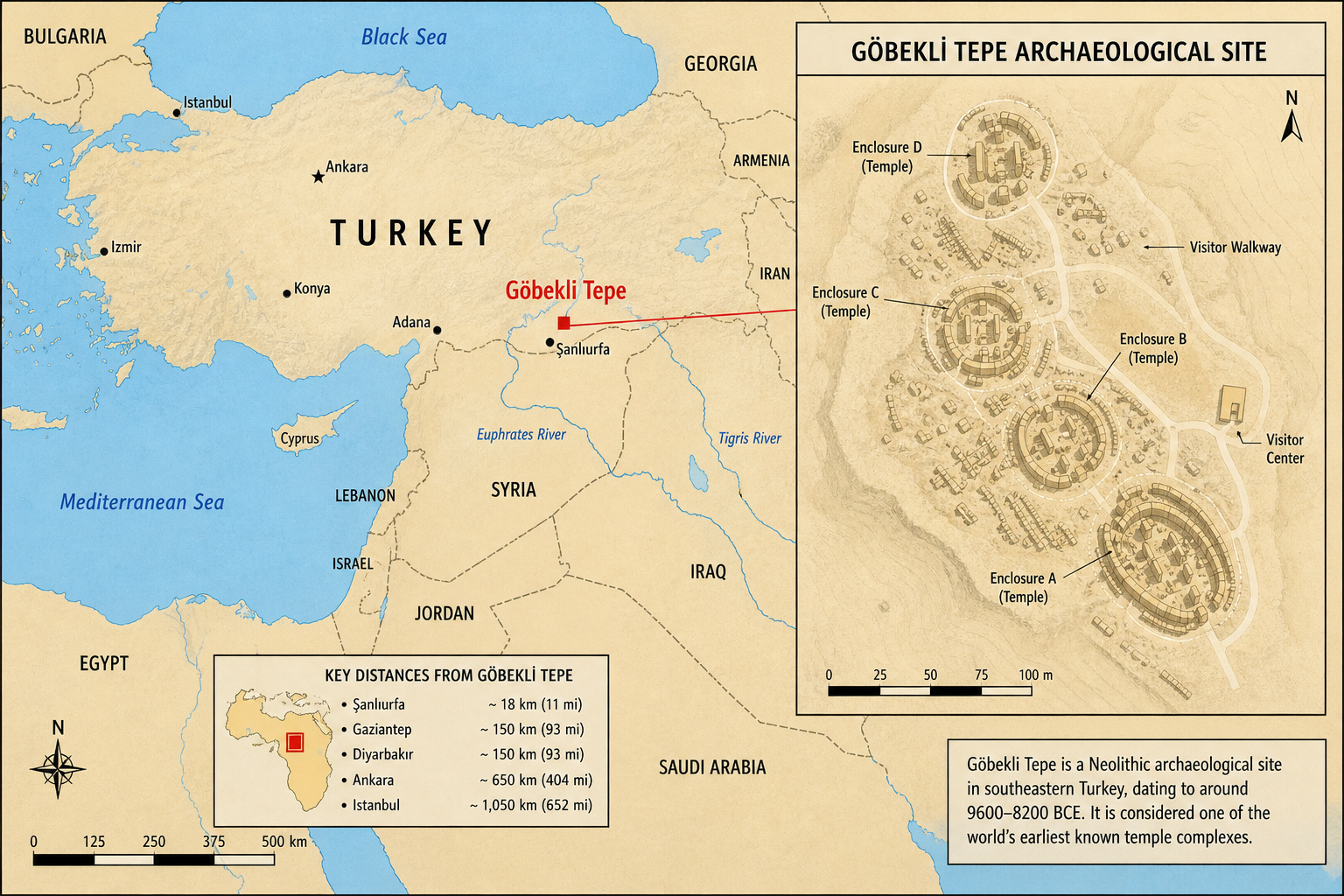
Göbekli Tepe
Long before the pyramids of Egypt rose from the desert, before cities, before writing, and even before the widespread adoption of agriculture, a structure was built on a hill in what is now southeastern Turkey. Known today as Göbekli Tepe, the site dates back to approximately 9600 BC, making it more than 11,000 years old. It predates Stonehenge by thousands of years and the pyramids of Giza by nearly seven millennia. Its existence has forced a reconsideration of how and when complex human societies first emerged.
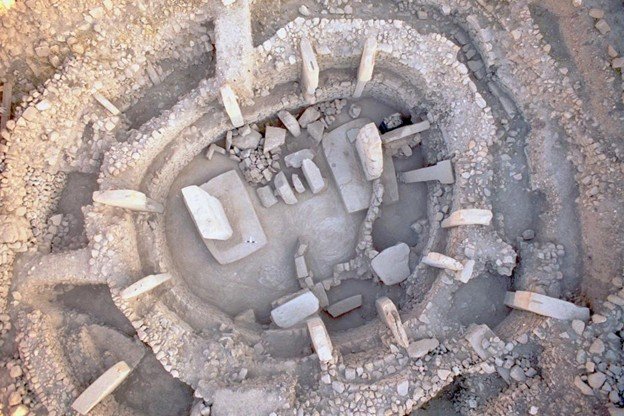
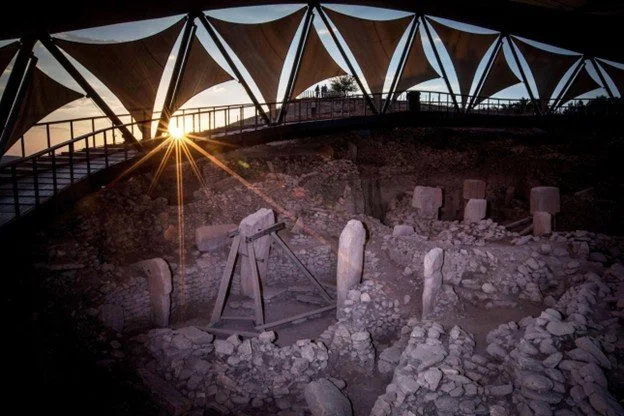
Göbekli Tepe sits on a limestone ridge near the modern city of Şanlıurfa, overlooking a landscape that would have once supported early hunter-gatherer communities. Unlike later settlements, there is no evidence that people lived at the site. There are no houses, no hearths, no signs of daily domestic life. Instead, what archaeologists uncovered beginning in the 1990s was a series of massive circular and oval enclosures constructed from carefully shaped stone pillars, some weighing up to ten or twenty tons.
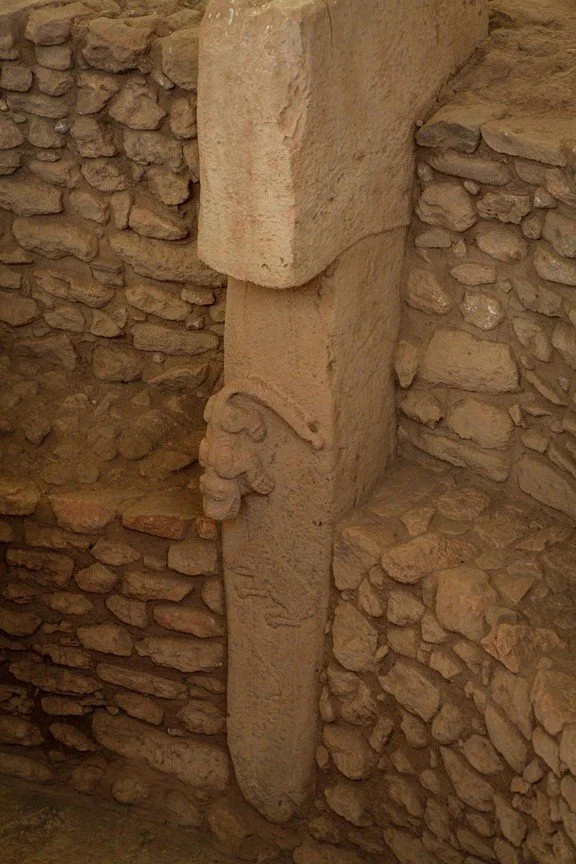
At the center of each enclosure stand two large T-shaped pillars, often rising more than sixteen feet high. These central pillars are surrounded by smaller ones set into stone walls, forming rings that appear to have been constructed with deliberate symmetry and planning. Many of the pillars are carved with intricate reliefs of animals, including foxes, snakes, birds, and wild boars. Some also feature abstract symbols and stylized human-like forms, with arms and hands etched into the stone, suggesting that the pillars themselves may represent figures rather than simple structural supports.
The scale of the construction is striking not only for its size, but for its age. At a time when human societies are believed to have consisted primarily of small, mobile groups, Göbekli Tepe demonstrates the ability to organize large numbers of people for a sustained and coordinated effort. The stone used at the site was quarried locally, cut, shaped, and transported without the use of metal tools, wheeled vehicles, or domesticated draft animals. The precision of the carvings and the placement of the pillars indicate a level of skill and planning that challenges traditional assumptions about prehistoric capabilities.
Perhaps even more surprising is the fact that Göbekli Tepe appears to have been intentionally buried. After centuries of use, the enclosures were filled in with rubble, stone fragments, and soil, effectively preserving them beneath the surface. New enclosures were then built nearby, suggesting a cycle of construction, use, and burial that repeated over generations. The reason for this deliberate covering remains unknown.
Unlike the pyramids, which are widely accepted as tombs, Göbekli Tepe has no clear funerary function. No burials have been found within the primary structures. Instead, the site is generally interpreted as a ceremonial or ritual center, a place where early humans gathered for purposes that may have included religious practices, social coordination, or shared symbolic activity. The presence of animal imagery, combined with the lack of domestic evidence, suggests that the site held a meaning that extended beyond survival and into the realm of belief.
Its age places it at a critical turning point in human history. Around the time Göbekli Tepe was constructed, humans were beginning the transition from hunter-gatherer lifestyles to settled agricultural communities. Some researchers have proposed that sites like Göbekli Tepe may have played a role in that transition, acting as gathering points that required organized food production and, in turn, encouraged the development of farming. In this view, the need to sustain large groups for ritual or construction may have driven the shift toward agriculture, rather than the other way around.
As with the pyramids, Göbekli Tepe has given rise to a range of interpretations that extend beyond the archaeological consensus. Some researchers suggest that the site encodes early astronomical knowledge, pointing to possible alignments with stars or constellations. Others propose that the carvings represent a symbolic system, perhaps an early form of communication or record-keeping that predates written language.
Another line of speculation focuses on the purpose of the structures themselves. The arrangement of the pillars, their scale, and their repeated patterns have led some to question whether Göbekli Tepe served a function beyond ritual gathering. The idea that it may have been designed with acoustic or vibrational properties has been explored, though not conclusively demonstrated. The enclosed spaces and stone surfaces do create unique sound environments, raising the possibility that sound, rhythm, or resonance played a role in whatever activities took place there.
There are also theories that the site reflects the legacy of an earlier or more advanced cultural phase, one that has left few other traces. The sudden appearance of such a complex structure, without clear developmental predecessors, has led some to suggest that knowledge or techniques may have been inherited rather than gradually developed. While this view remains outside mainstream archaeology, it speaks to the broader sense that Göbekli Tepe represents a leap rather than a step in human capability.
What is not in dispute is that the site changes the timeline of human history. It demonstrates that large-scale, coordinated construction and symbolic expression existed long before cities and states. It suggests that the impulse to gather, to build, and to create meaning may have been a driving force in the formation of civilization itself.
Göbekli Tepe does not offer clear answers. It offers evidence, structure, and silence. It stands at the beginning of the known human story, already fully formed, already complex, already beyond what it should have been for its time.
Like the pyramids, it forces a question that remains unresolved.
FOR MORE INFORMATION SEE DEEP RESEARCH