Gunung Padang
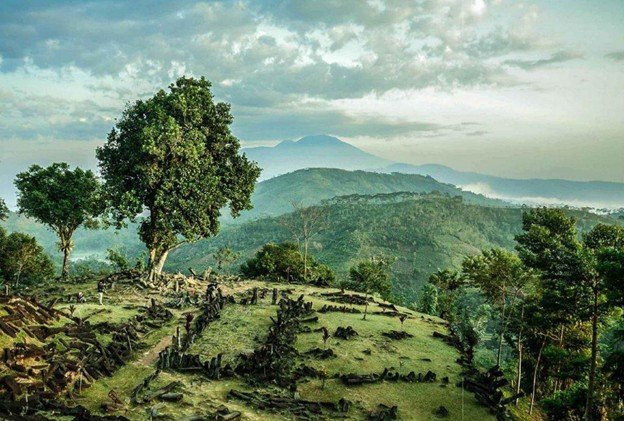
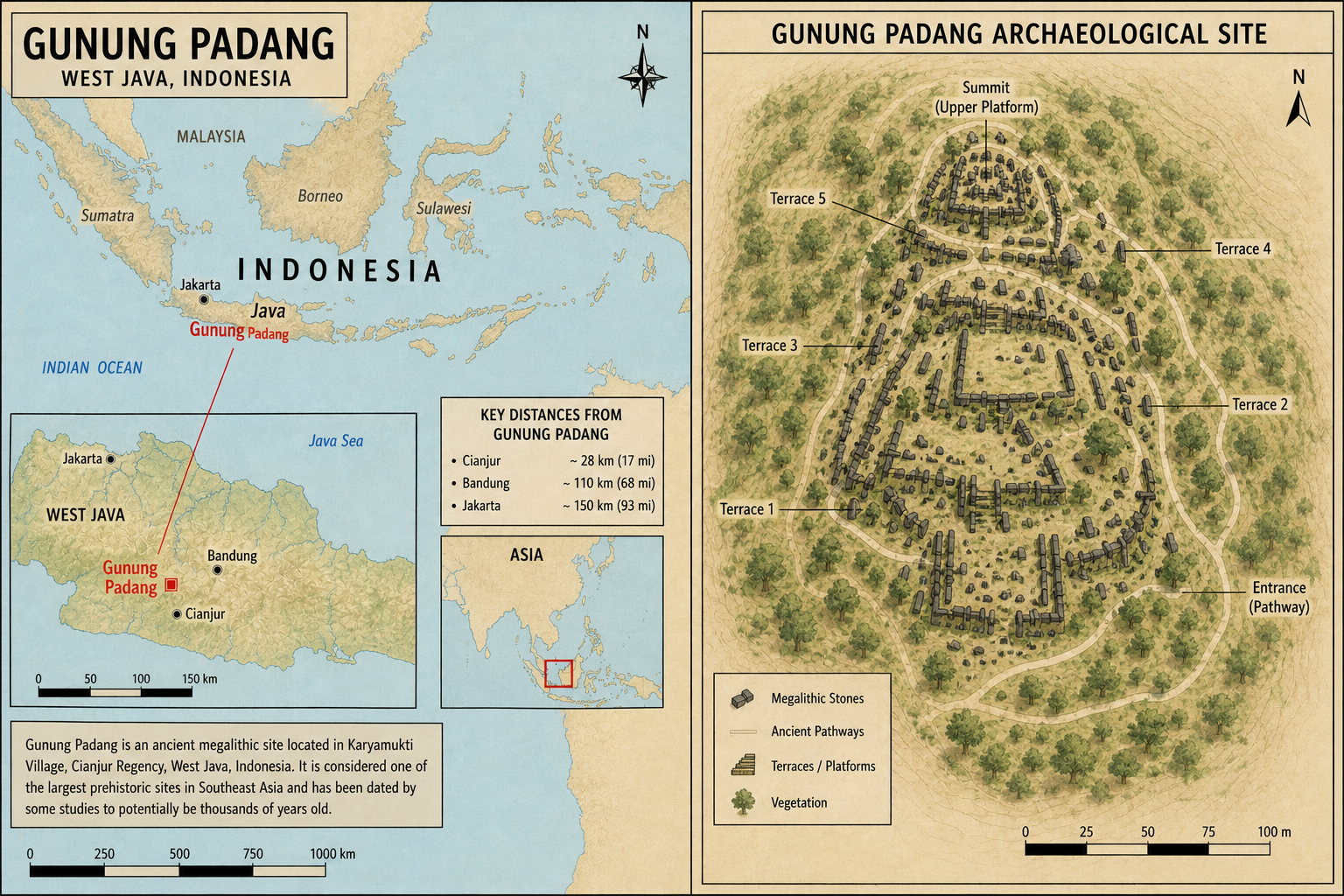
Rising from the dense green highlands of West Java in Indonesia, Gunung Padang appears at first to be a natural hill. Only as one begins to climb does its structure reveal itself. Beneath the vegetation and soil, the slope resolves into a series of stepped terraces, built from tightly arranged stone columns that form platforms, pathways, and retaining walls. The higher one moves, the more deliberate the construction becomes, until the summit opens into a broad arrangement of upright stones and aligned blocks that suggest a purpose far beyond simple habitation.
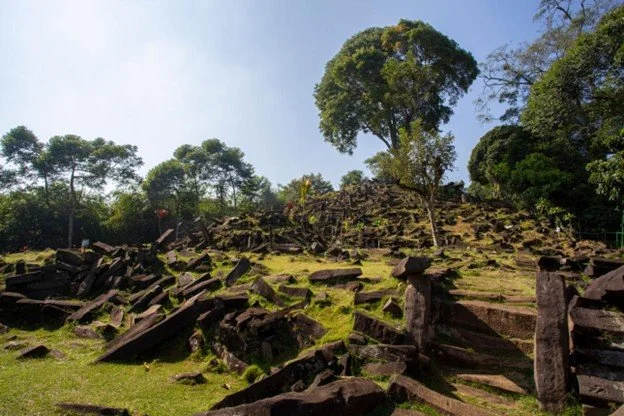
Gunung Padang is often described as the largest megalithic site in Southeast Asia. Its visible terraces are composed primarily of andesite columns, a volcanic stone that fractures into long, hexagonal shapes. These columns have been stacked both horizontally and vertically, forming stable surfaces and walls that have endured for centuries. The terraces ascend in a sequence, each level connected by narrow stairways that guide movement upward in a controlled progression. Like other ancient sites, the experience of the structure is inseparable from its design. The climb is not incidental. It is part of the function.
Archaeological study has dated the visible structures of Gunung Padang to roughly the first millennium BC, placing it within the broader tradition of megalithic construction in the region. In this interpretation, the site is understood as a ceremonial or ritual center, built by early agricultural societies that organized labor and resources to create a place of gathering and symbolic importance. The arrangement of stones at the summit, along with the absence of clear domestic features, supports the idea that the site was used for activities beyond everyday life.
The layout of Gunung Padang suggests intention at multiple scales. The terraces are not randomly placed, but aligned along the natural contours of the hill, creating a layered structure that integrates with the landscape rather than replacing it. From the summit, the surrounding valleys stretch outward, reinforcing the sense that the site occupies a position of both visibility and significance within the region. The stonework itself, though irregular in shape, is fitted together with a level of care that reflects planning and experience.
Unlike sites such as Giza or the Maya cities, Gunung Padang has yielded little in the way of inscriptions or carved imagery. Its meaning must be inferred from its structure, its placement, and its materials. This absence of explicit narrative has made it one of the more debated sites in the archaeological world.
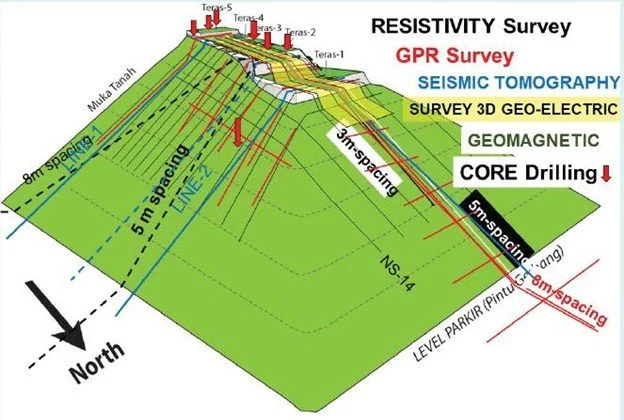
In recent years, Gunung Padang has become the focus of a more controversial line of investigation. Subsurface imaging, including ground-penetrating radar and seismic studies, has suggested the possibility that the visible terraces represent only the uppermost portion of a much larger structure buried beneath the hill. Some interpretations of this data propose multiple layers of construction, extending downward to depths that would significantly predate the accepted age of the site.
According to these interpretations, the deepest layers could date back as far as 10,000 to 20,000 years, a timeframe that would place the origins of the structure well before the rise of known civilizations. In this view, Gunung Padang is not simply a megalithic site built on a hill, but a deliberately constructed pyramid-like formation that has been covered and modified over successive periods of human activity.
These claims remain highly contested. Many archaeologists argue that the subsurface anomalies can be explained by natural geological formations, particularly given the volcanic origins of the region. Andesite columns can form naturally, and the hill itself may be a volcanic structure that was later adapted by human builders. The challenge lies in distinguishing what is natural from what is constructed, especially in a site where the two are so closely intertwined.
Despite the debate, the idea of a layered structure has gained attention because it echoes a pattern seen at other ancient sites: construction, modification, and burial occurring over long periods of time. Even within the accepted framework, Gunung Padang shows evidence of multiple phases of use, with later builders reworking earlier structures to create the terraces visible today.
Another area of speculation concerns the purpose of the site. The arrangement of terraces, the use of dense volcanic stone, and the positioning within the landscape have led some to explore whether Gunung Padang was designed with properties beyond the visible. The stone itself is capable of transmitting vibration, and the enclosed spaces between columns create cavities that interact with sound. While there is no conclusive evidence that the builders intended to exploit these properties, the physical characteristics of the site allow for complex interactions between structure, material, and environment.
What sets Gunung Padang apart is the uncertainty that surrounds it. The pyramids of Giza are defined by their precision and historical context. Göbekli Tepe is defined by its age and its challenge to the timeline of human development. Toniná is defined by its layered architecture and recorded history. Gunung Padang exists somewhere between these categories, partially understood, partially hidden, and still under investigation.
It is a structure that may extend deeper than it appears.
A site built in layers, or on layers, or through layers.
A place where the boundary between natural formation and deliberate construction is not entirely clear.
And because of that, it leaves open a different kind of question.
Not just what was built. But how much of it is still buried.
FOR MORE INFORMATION SEE DEEP RESEARCH