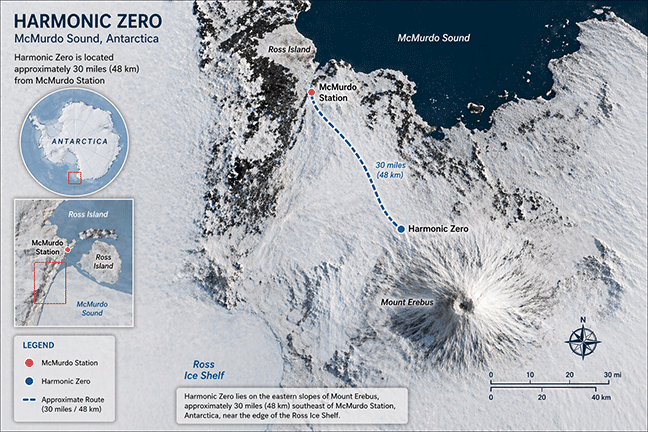
Harmonic Zero
South of the open ocean, beyond the last permanent human outpost at McMurdo Station, the landscape changes from defined terrain to something less certain. The Ross Ice Shelf extends outward as a flat, frozen expanse, its surface appearing stable, but in reality moving slowly, continuously, toward the sea. Beneath it lies not a uniform layer of ice, but a complex interface of pressure, temperature, and geology. It is within this region, roughly an hour from McMurdo, that the fictional Harmonic Zero exists.
In known geography, this area sits at the edge of one of the most dynamic boundaries in Antarctica. The Transantarctic Mountains divide the continent, separating the older, more stable East Antarctic craton from the geologically younger and more active West Antarctic region. Beneath the ice are mountain ranges, valleys, and subglacial basins, many of which have only been mapped through radar and seismic imaging. Some of these buried features rival major surface ranges in scale, rising and falling in complete darkness under thousands of feet of ice.
The ice itself is not static. It flows. It compresses. It fractures under stress and reforms under pressure. Temperatures at depth can approach the melting point, creating subglacial lakes and channels of moving water. These hidden systems shift over time, altering the internal structure of the ice shelf and the land beneath it. The result is a region that appears still from above but is in constant motion below.
Harmonic Zero, as described in The Source, is not positioned on the surface, but embedded within this environment. It is located beneath the ice, anchored to the underlying geology rather than the moving shelf above. The chamber exists in a zone where stability is not obvious, but must be maintained. That distinction matters. The ice can move. The structure cannot.
Geologically, the Ross region provides a plausible setting for such a construct. The underlying bedrock includes ancient formations that have remained stable for hundreds of millions of years. At the same time, the overlaying ice introduces continuous stress, pressure, and subtle vibration. Any structure placed at the interface between these layers would experience both extremes: deep stability and constant disturbance.
There are also broader questions about Antarctica itself that intersect with the idea of Harmonic Zero. One of the most debated is whether parts of the continent were once ice-free within human timescales. The Piri Reis Map has often been cited in this context. Created in the early 16th century, the map appears to depict a southern landmass that some have interpreted as Antarctica without its ice cover.
Most historians and cartographers attribute this to misinterpretation or the merging of known coastlines with speculative geography. However, the persistence of the idea reflects a larger question: how much of Antarctica’s past remains hidden beneath the ice.
Geological evidence confirms that Antarctica was once part of the supercontinent Gondwana, connected to Africa, South America, Australia, and India. In that distant past, it supported forests, rivers, and a temperate climate. Over millions of years, continental drift carried it southward, and the formation of circumpolar ocean currents isolated it thermally, allowing ice sheets to form and expand.
Within that long timeline, there are periods where portions of the continent may have experienced reduced ice coverage, particularly along coastal regions. Sediment cores and subglacial mapping suggest that the ice has advanced and retreated in complex cycles, though not necessarily within the timeframe of known human civilization.
What remains unresolved is the full extent of what lies beneath. Radar imaging has revealed mountain ranges, valleys, and structures that appear natural but remain only partially understood. Entire landscapes exist under the ice, preserved in conditions that have changed little for millions of years.
In the context of Harmonic Zero, these uncertainties create a framework rather than a contradiction. A structure placed deep within Antarctica would not need to be visible to be present. It would not need to be recent to remain intact. It would only need to exist at a point where the underlying geology provides a fixed reference, something the surface no longer offers.
Harmonic Zero is described as that reference. A location where stability is defined, not observed. Where the shifting layers above can be measured against something that does not move. In a world where the surface changes, where ice flows and continents drift, such a point would not announce itself. It would remain buried, silent, and constant.
Waiting to be found.