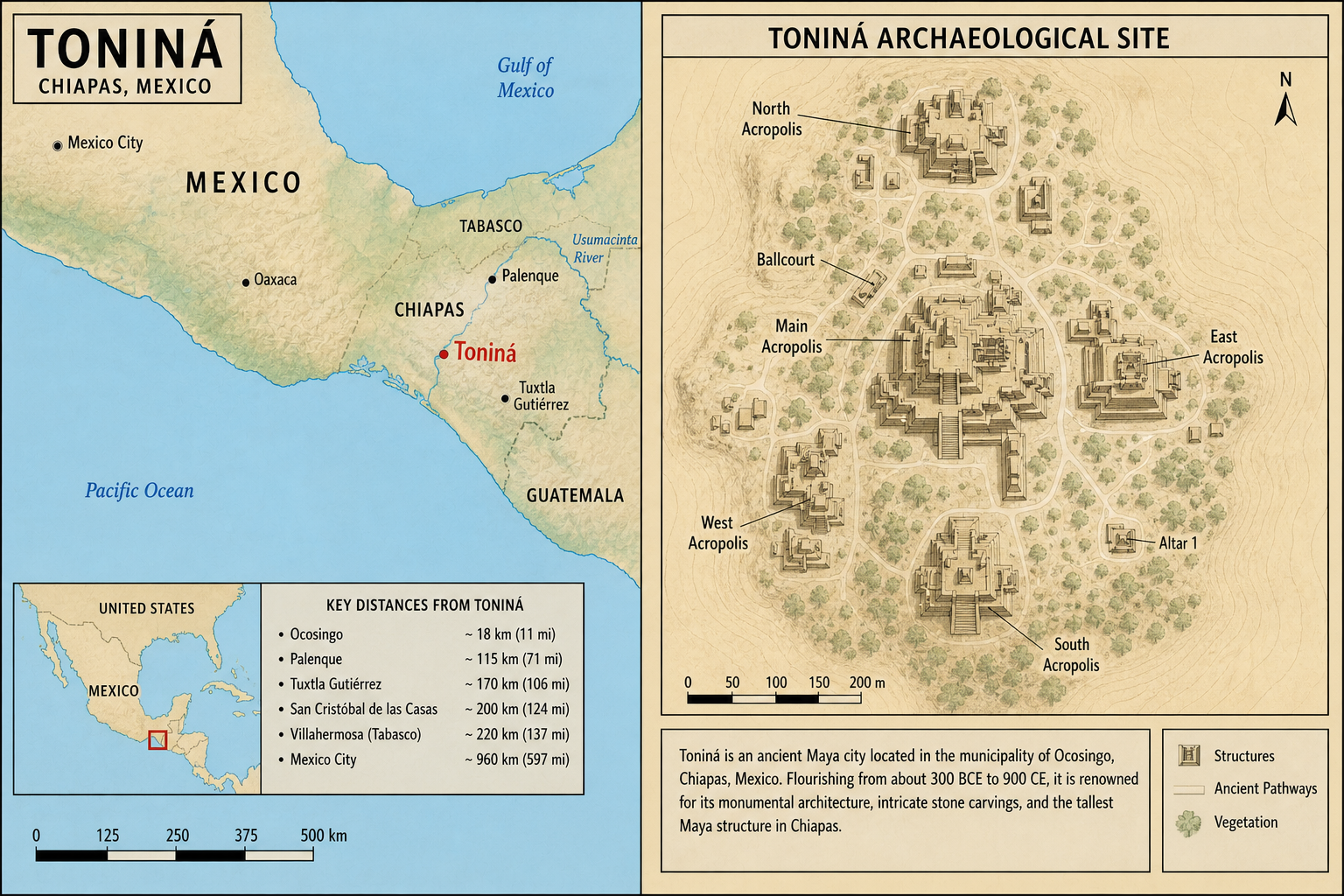
Toniná
Hidden within the highlands of Chiapas in southern Mexico, the ancient Maya city of Toniná rises not as a single pyramid, but as a vast terraced mountain of stone. Unlike the clean geometric lines of Giza or the circular enclosures of Göbekli Tepe, Toniná presents itself as a layered structure, a steep, ascending complex that blends architecture with landscape. It is both constructed and carved, a city and a monument at the same time.
Toniná reached its height between the 7th and 9th centuries AD, during the Late Classic period of Maya civilization. Its position in the Ocosingo Valley gave it strategic importance, and the site became known as a powerful regional center, often in conflict with nearby city-states. Inscriptions found throughout the complex document military victories, political rivalries, and the movements of rulers, providing one of the more detailed historical records among Maya sites.
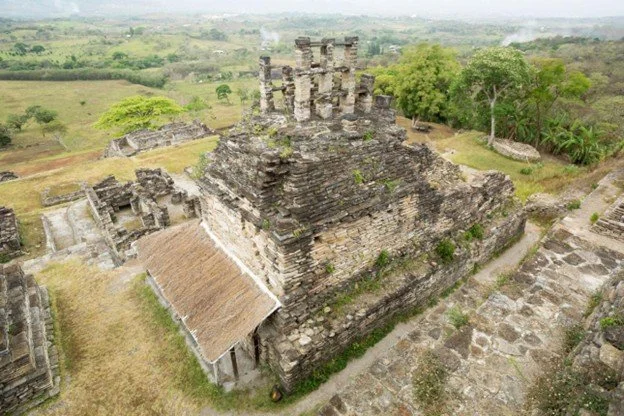
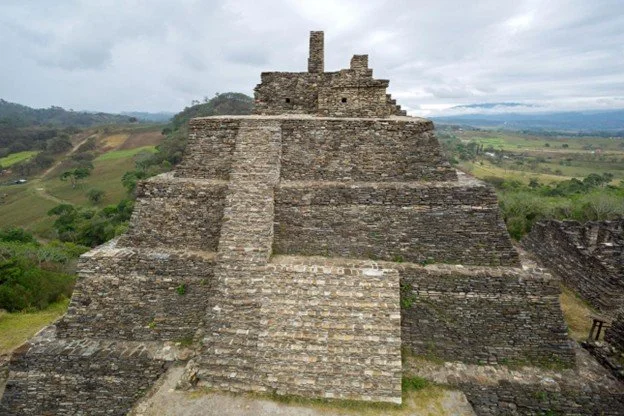
The core of Toniná is its acropolis, a massive stepped platform rising approximately 230 feet above the surrounding terrain. This makes it one of the tallest structures in Mesoamerica, exceeding even some of the better-known pyramids of the region in vertical scale. Rather than a single pyramid, the acropolis is composed of seven distinct terraces, each supporting temples, altars, and ceremonial spaces. The entire structure stretches upward in a controlled progression, creating a sense of ascent that is both physical and symbolic.
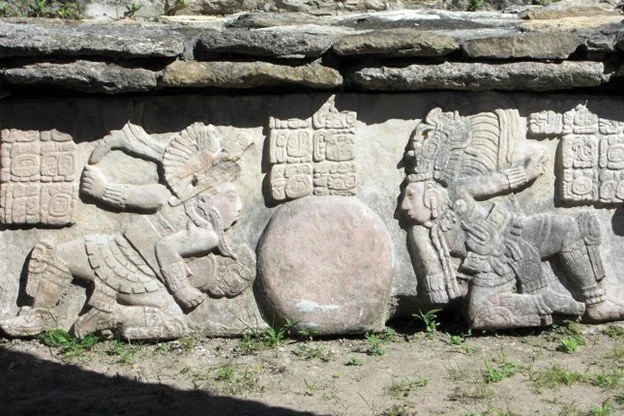
Stone stairways connect each level, guiding movement through the complex in a deliberate sequence. As one moves upward, the surrounding valley falls away, replaced by an expanding view of the horizon. The architecture directs not just where people go, but how they experience the space, step by step, level by level. Carved monuments and sculptural panels line parts of the structure, many depicting rulers, captives, and scenes of ritual significance. The detail and craftsmanship reflect a culture deeply invested in both power and expression.
Toniná is also known for its extensive ball court, one of the largest in the Maya world. The ballgame held here was not simply a sport, but a ritualized event tied to cosmology, conflict, and the movement between worlds. The presence of multiple temples, altars, and carved stelae suggests that the site functioned as both a political center and a ceremonial hub, where authority was displayed and reinforced through architecture and ritual.
Unlike many other Maya cities, Toniná shows evidence of continued activity even as other major centers declined. Some inscriptions suggest occupation into the early 10th century, beyond the period when much of the southern Maya lowlands experienced collapse. This persistence has drawn attention, raising questions about how Toniná maintained stability while other regions fragmented.
Archaeologically, Toniná is understood as a fortified and influential Maya city, shaped by conflict and driven by political ambition. Its inscriptions provide a clear narrative of warfare, including documented victories over the nearby city of Palenque. The architecture reflects this identity, with its elevated terraces offering both defensive advantage and symbolic dominance over the surrounding region.
els, carrying in some areas and dissipating in others. While there is no direct evidence that the builders intended to manipulate sound, the physical properties of the site allow for controlled auditory experiences, particularly during gatherings or rituals.
Yet, as with other ancient sites, Toniná invites interpretations that extend beyond its recorded history.
The seven-tiered structure of the acropolis has drawn particular attention. While it can be understood as a practical and ceremonial design, the repetition of levels suggests a deliberate pattern, one that may carry symbolic meaning beyond simple construction. In Maya cosmology, layered worlds were a recurring concept, with multiple levels of the underworld and the heavens. The ascent through Toniná’s terraces may have represented a movement through these layers, a structured progression between realms.
Some researchers have also noted the site’s alignment with the surrounding landscape. The orientation of the terraces and structures appears to engage with the natural contours of the valley, creating a relationship between built space and environment. This has led to speculation that the site was positioned and designed with broader geographic or astronomical considerations in mind, though definitive conclusions remain limited.
There is also growing interest in the materials and construction methods used at Toniná. The density of the stone, the arrangement of terraces, and the enclosed spaces within the structure create distinct acoustic environments. Sound behaves differently across the levels, carrying in some areas and dissipating in others. While there is no direct evidence that the builders intended to manipulate sound, the physical properties of the site allow for controlled auditory experiences, particularly during gatherings or rituals.
More speculative interpretations suggest that Toniná represents not just a political or ceremonial center, but a focal point within a larger regional network. Its prominence, durability, and continued occupation raise the possibility that it held a function that extended beyond local governance. The idea that it served as a stabilizing or coordinating site, whether culturally, politically, or in ways not yet fully understood, remains an open question.
What distinguishes Toniná is not a single feature, but the integration of many. It is a structure that combines scale, complexity, and continuity. It reflects a society capable of sustained effort, detailed record-keeping, and long-term vision. At the same time, it preserves elements that resist simple explanation, patterns and choices that suggest intention beyond immediate necessity.
Toniná does not present itself as a mystery in the same way as older sites like Göbekli Tepe. Its builders are known. Its history is partially recorded. Its purpose, at least in part, is understood.
And yet, like the pyramids, like the earliest structures of human civilization, it leaves a space between what is known and what is implied.
A structure built in layers. A system designed for ascent. A place where meaning accumulates with height.